
Warehouse bird control in Sydney starts with identifying how birds enter, where they settle and what encourages them to remain. Effective management combines suitable exclusion, practical door arrangements, housekeeping and monitoring. The plan must also accommodate deliveries, machinery, staff movements and maintenance access.
A warehouse cannot simply stop receiving goods whenever birds appear. Managers need measures that reduce access without creating avoidable disruption or interfering with safe operations.
The starting point is a site assessment covering both the building and its daily routines. That provides a clearer basis for action than repeatedly chasing birds from the dispatch floor.
Why do birds enter warehouses and factories?
Open access, sheltered structures and available resources can make industrial buildings attractive to birds. Entry may be occasional or develop into repeated occupation.
- Loading activity: Large doors provide access while vehicles and goods move through. Record whether birds enter during deliveries or use doors left open between movements.
- Shelter: Canopies, beams and recessed roof areas may provide resting places. Indoor protection from weather can make the building worth revisiting.
- Food and water: Spilled ingredients, exposed feed or waste can support continued visits. Investigate the surrounding yard as well as the interior.
Genera’s commercial guidance identifies loading docks, frequent door movements, storage conditions and waste management among relevant warehouse assessment considerations. Genera
What should an industrial bird assessment establish?
The assessment should connect the species and observed behaviour with access routes, affected areas and operational constraints. A bird seen indoors does not reveal the full extent of activity.
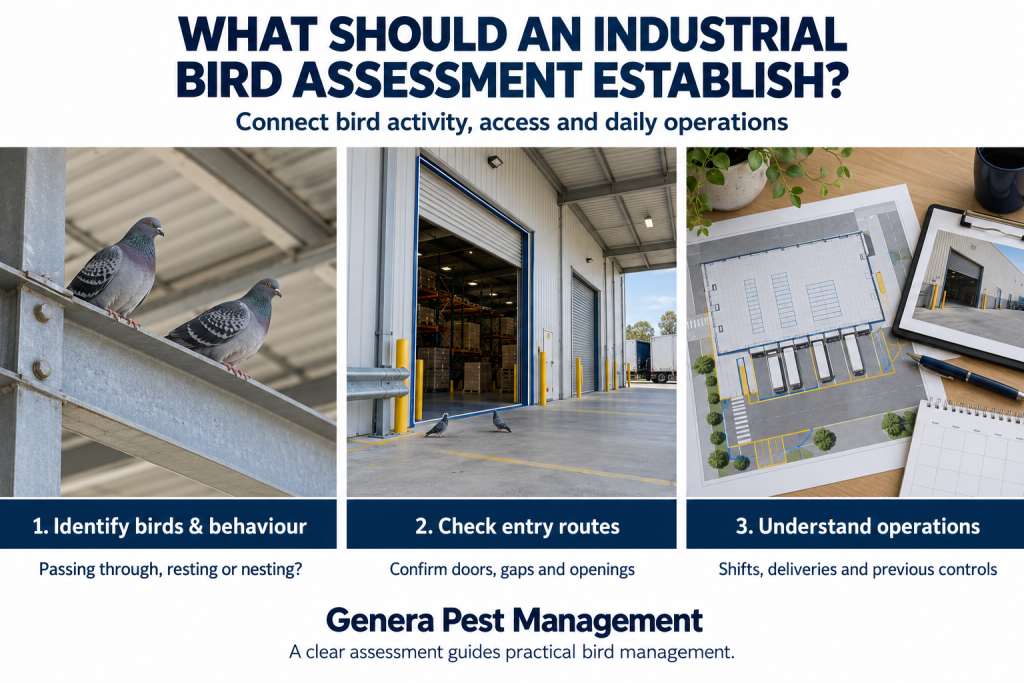
- Identity and behaviour: Establish whether birds are passing through, feeding, resting or nesting. Different activities can require different responses.
- Entry routes: Identify doors, damaged covers or other openings birds actually use. Distinguish confirmed routes from suspected defects.
- Operational context: Share shift patterns, delivery peaks and previous control attempts. These details help explain activity that may be absent during inspection.
Provide a site plan where available. Mark sightings and fouling locations so the assessor can investigate patterns across the facility.
How should loading docks and open doors be managed?
Door management should reduce unnecessary access while preserving safe, practical loading operations. The appropriate changes depend on vehicle movement, ventilation and building use.
- Review opening periods: Identify doors that remain open without an operational reason. Agree on workable closure arrangements with supervisors.
- Assess doorway options: Suitable screens, closures or other engineered arrangements may deserve consideration. Ask how they interact with sensors, visibility and clearance.
- Investigate exterior resting points: Birds gathering above a dock may repeatedly enter when doors open. Include canopies and adjacent structures in the assessment.
Do not make unauthorised changes to fire exits, ventilation or safety systems. Coordinate proposed modifications with the relevant building and operational specialists.
Why do roof structures and overhead services matter?
Birds may remain above normal working height even when the floor appears quiet. Inspecting overhead resting locations helps explain recurring contamination below.
- Beams and trusses: Record concentrations of droppings beneath structural members. They can help direct inspection towards regularly used locations.
- Services and equipment: Identify lighting, pipework or other features near activity. Proposed protection must accommodate servicing and equipment functions.
- Concealed nesting: Report repeated visits to roof junctions or sheltered recesses. Occupancy needs checking before access is closed.
Avoid sending staff onto racking or makeshift platforms to investigate. Arrange suitable access for inspection and any subsequent work.
What should managers do if stock is exposed?
Refer potentially affected stock to the site’s quality or stock-control process before movement or release. The response depends on the product, packaging and evidence.
- Identify the exposure: Record the affected pallet, batch or storage position. Distinguish contamination of outer packaging from possible exposure of the contents.
- Control movement: Notify the responsible manager and follow the site’s hold or segregation procedure. Avoid transferring affected goods through clean areas unnecessarily.
- Document decisions: Record assessment, cleaning or disposal decisions and who authorised them. A pest contractor’s visit does not automatically clear goods for use.
For food businesses, NSW Food Authority guidance recognises that pests can contaminate food, equipment and surfaces. It requires practical measures addressing pest entry, harbourage and pests present. NSW Food Authority
When does warehouse bird netting make sense?
Warehouse bird netting may suit defined overhead spaces that can be enclosed without obstructing operations or maintenance. It is one option rather than a default solution.
- Canopy protection: Netting may prevent access to sheltered structures above loading areas. The design must account for the building’s actual geometry.
- Internal exclusion: Some overhead spaces may be suitable where the boundary can be completed. Identify services and maintenance routes before design.
- Species selection: Mesh and installation must suit the birds involved. Confirm how gaps and access openings will be addressed.
NSW guidance recognises netting as potentially effective and humane when correctly applied and maintained. It also identifies practical limitations and wildlife risks requiring regular checks. dpird.nsw.gov.au
What other exclusion options should be considered?
Use repairs, barriers or surface protection according to the access or resting problem identified. Different sections of one facility may need different measures.
- Opening repairs: Damaged covers or building gaps may require appropriate repairs. Confirm vacancy and preserve necessary ventilation.
- Ledge protection: Suitable products may discourage landing on particular surfaces. They do not prevent entry through an open loading door.
- Combined work: A canopy barrier and doorway changes may address separate parts of the same problem. Ask what each component contributes.
Explore Genera’s bird proofing services when comparing options. Request a proposal showing coverage and limitations.
How can work proceed with minimal disruption?
Schedule assessment, installation and cleaning around agreed operating constraints. The contractor and site management need a shared plan before attendance.
- Separate traffic: Identify work zones and alternative routes for staff and deliveries. Avoid placing contractors beneath active forklift movements.
- Coordinate shutdowns: Explain equipment isolation, permits and maintenance windows. Relevant site personnel should confirm what must stop and when.
- Communicate changes: Brief shift supervisors, cleaners and delivery coordinators. Include contingencies for access delays or incomplete work.
SafeWork NSW recommends separating pedestrians and forklifts and giving contractors clear instructions before entering forklift areas. Bird management work should fit the site’s traffic arrangements. SafeWork NSW
What housekeeping changes support prevention?
Housekeeping should remove avoidable feeding opportunities and keep problem areas inspectable. It supports exclusion rather than replacing it.
- Spills: Assign responsibility for spilled grain, ingredients or feed. Ensure cleanup includes areas beneath equipment where safe access is available.
- Waste: Keep containers closed and surrounding areas tidy. Check collection points during busy periods.
- Storage: Remove unnecessary materials that conceal activity or obstruct inspection. Maintain suitable access around relevant building areas.
For food premises, NSW guidance specifically recommends clean waste areas, regular rubbish removal and maintaining premises and equipment in a clean condition. NSW Food Authority
How should fouling and nesting material be addressed?
Cleaning and nest management need their own assessment and scope. Installing protection does not automatically remove existing contamination.
- Occupancy checks: Establish whether nests contain eggs or dependent young. Check relevant wildlife requirements before disturbance.
- Cleaning controls: Assess dust, access and nearby stock or equipment. Avoid dry disturbance of accumulated droppings.
- Separate responsibilities: Confirm whether the bird contractor, cleaning specialist or another trade handles each task. Record exclusions in the quotation.
NSW Health advises precautions when cleaning areas where wild birds have roosted, including appropriate gloves and a properly fitted P2 respirator. Extensive contamination warrants specialist assessment. www.health.nsw.gov.au
What monitoring should follow the work?
Monitoring should establish whether access and fouling have reduced in the agreed areas. Use consistent records that staff can maintain across shifts.
- Activity reports: Record location, time and observed behaviour. Avoid duplicate reports without identifying the same event.
- Installation checks: Report damaged barriers or unsecured maintenance openings. Arrange professional inspection where access is restricted.
- Management review: Compare findings with the original objective. Reassess when layouts, stock handling or door use change.
Include actions, responsible people and completion dates in the bird management record. This makes unresolved issues visible rather than leaving them between contractors and departments.
Frequently asked questions about industrial bird management
These answers address common decisions before arranging warehouse assessment.
Can a warehouse stay open during bird control work?
Some work can be staged, while other tasks need local restrictions. The decision depends on the method and work area.
- Discuss operating constraints before quotation. Confirm temporary closures in writing.
Will keeping doors closed solve the problem?
It may reduce access, but existing indoor occupation or other openings still need checking.
- Review unnecessary opening periods. Assess birds already using the structure.
Is netting suitable above pallet racking?
It requires assessment of clearances, equipment and servicing requirements. Suitability cannot be established from the location alone.
- Involve relevant building specialists. Preserve operational and emergency functions.
Should contaminated stock always be discarded?
The decision depends on exposure, packaging and applicable quality procedures. A bird sighting alone does not establish every item is affected.
- Refer findings to the responsible manager. Document the assessment and decision.
How often should warehouses be inspected for birds?
Frequency should reflect activity, product sensitivity and site requirements. There is no universal schedule for every facility.
- Agree on routine observations and professional reviews. Increase attention when renewed activity appears.
Build prevention into daily operations
Start with an assessment that connects bird activity with building access and normal workflows. Genera Pest Management can help industrial managers discuss appropriate protection and monitoring.
- Share the evidence: Provide sightings, affected areas and operating constraints.
- Request a coordinated plan: Confirm access, exclusion, cleaning and follow-up responsibilities.
Call Genera Pest Management on 1300 149 549 or book a discovery call to discuss warehouse bird control in Sydney.