
Commercial bird control in Sydney should combine assessment of bird activity with practical planning for building access, installation and maintenance. On commercial buildings and high-rises, recommendations must account for façades, ledges, rooftop equipment and the contractors responsible for servicing them.
If birds repeatedly foul an entrance or occupy a roof plant area, facilities managers need more than a product recommendation. They need a clear scope, suitable access arrangements and work that fits the building’s operations.
The starting point is understanding where birds are active and how each affected area is used. That information guides a coordinated plan rather than a series of disconnected repairs.
Why do complex buildings need a coordinated bird management plan?
Bird activity can extend across several elevations, roof sections and shared facilities. Treating the most visible location may leave other important areas unassessed.
- Connected activity: Birds may rest on an upper ledge while fouling a lower entrance. The source and affected surface may require different attention.
- Multiple responsibilities: Building owners, tenants and service contractors may control different areas. Establish who can authorise work before scheduling it.
- Changing conditions: Façade repairs, signage replacement and plant upgrades can alter existing protection. Bird management should remain visible within maintenance planning.
Genera’s published commercial information describes inspection of species, nesting and resting locations before recommending a response for commercial properties. Pest Control Company Sydney
What should the initial assessment establish?
The assessment should identify the birds, their activity and the building constraints affecting management. It should distinguish confirmed findings from areas that could not be inspected.
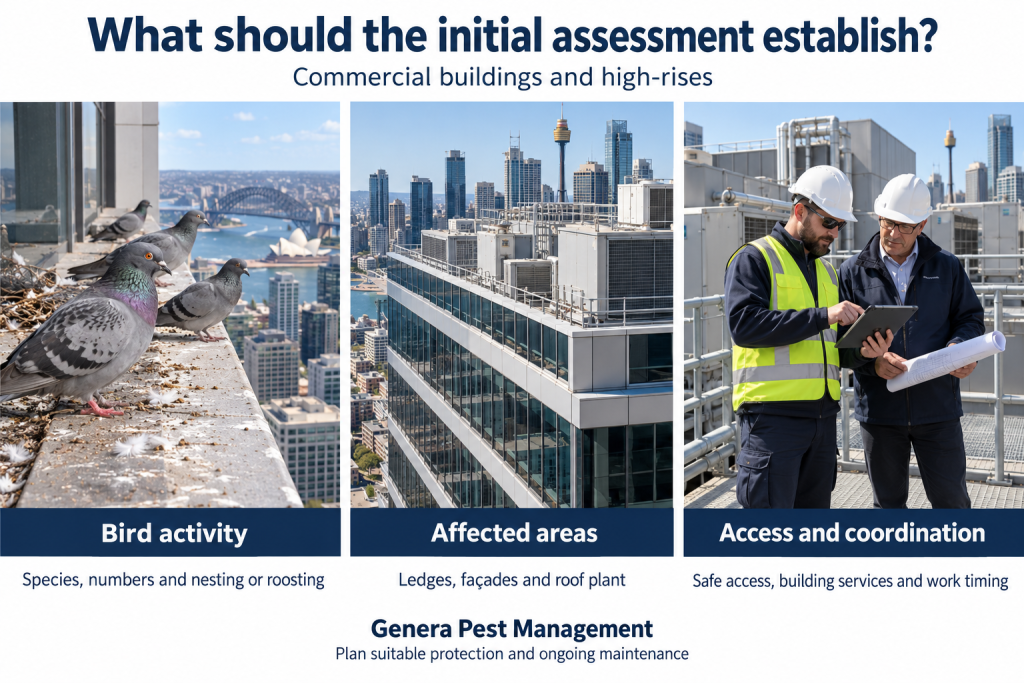
- Activity locations: Record nesting, resting and entry separately. Ask whether observations indicate occasional use or established occupation.
- Affected areas: Map fouling around entrances, terraces, glazing and equipment. Include complaints from tenants and cleaners.
- Inspection limits: Identify concealed or inaccessible spaces. Further access may be needed before the final installation scope can be confirmed.
Provide drawings, previous reports and safely taken photographs where available. A marked elevation can make locations clearer than descriptions such as “the ledge above reception.”
How should façades and ledges be assessed?
Façade protection needs to match the surface, bird behaviour and architectural requirements. Visibility matters, but the system must still provide suitable coverage.
- Ledge dimensions: Ask how the full usable surface will be addressed. Corners, brackets and adjacent features can leave alternative resting places.
- Surface condition: Identify damaged finishes or areas needing repair. The proposed attachment must suit the supporting material.
- Appearance: Request product samples or photographs of comparable installations. Review them against the actual background and viewing distances.
For example, an exposed parapet and a deep sheltered recess may require different approaches. Their position on the same elevation does not make them equivalent.
What requires attention around rooftop plant?
Rooftop bird management must preserve equipment operation and the access needed for servicing. Protection should be planned with those responsible for the plant.
- Service routes: Identify walkways, inspection points and equipment panels. Proposed barriers should not obstruct necessary access.
- Equipment functions: Consult the relevant contractor about clearances, airflow and components near the proposed installation. Avoid assuming a barrier can attach anywhere.
- Contamination: Record fouling around equipment separately from suspected equipment damage. Relevant trades should assess mechanical or electrical concerns.
Include existing solar equipment and roof maintenance requirements in the discussion. Bird protection should not create a new obstacle for routine or emergency servicing.
Which discreet systems may suit commercial buildings?
The appropriate system depends on the species, behaviour and area needing protection. A less visible option is useful only where it suits the problem.
- Wire systems: These may suit certain exposed ledges where appearance is important. Manufacturer guidance limits conventional Birdwire applications by species and intensity of activity.
- Spikes: Suitable products may discourage landing on selected surfaces. Coverage and installation details still need assessment.
- Netting: Exclusion may suit recessed spaces or selected structures. The mesh, perimeter supports and maintenance openings should form part of the design.
Bird Barrier describes its wire system as discreet but intended for suitable exposed ledges where birds rest rather than nest. That illustrates why appearance cannot be the sole selection criterion. Bird Barrier
How should access constraints influence planning?
Access should be assessed before installation methods and costs are finalised. Building height alone does not establish which approach is suitable.
- Available arrangements: Provide information about roof access and existing maintenance systems. Competent specialists must establish whether these can support the proposed work.
- Work areas below: Identify entrances, terraces, roads and neighbouring property beneath the installation. Discuss restrictions and protection arrangements.
- Weather and scheduling: Ask how conditions could affect access and completion. Agree on communication if work is postponed.
SafeWork NSW requires fall risks to be managed using the hierarchy of controls. Existing equipment or a proposed access method should not be accepted without assessing suitability. SafeWork NSW
How can contractors coordinate without disrupting building operations?
Assign clear responsibilities and agree on the sequence before contractors attend. This prevents gaps between bird management, cleaning and building repairs.
- Nominate a coordinator: Establish who controls scheduling, access and tenant communication. Give contractors one route for reporting changes.
- Agree on dependencies: Identify whether repairs, cleaning or occupancy checks must occur before installation. Confirm who releases each stage for the next.
- Control overlapping work: Discuss other contractors operating nearby. Work above occupied areas also needs appropriate falling-object controls.
SafeWork NSW guidance prioritises preventing falling objects and identifies exclusion zones where necessary. Ground-level arrangements belong in the work plan, not as an afterthought. SafeWork NSW
What should the project brief contain?
A useful brief connects the observed problem with the building’s operating requirements. It helps contractors price comparable work.
- Evidence: Include activity locations, photographs and previous measures. State which findings remain uncertain.
- Constraints: Identify operating hours, tenant access and appearance requirements. Include relevant approval arrangements.
- Deliverables: Request a defined scope and handover information. Clarify the documentation needed for future maintenance.
| Planning item | Information to establish |
|---|---|
| Protection area | Specific elevations, ledges or rooftop spaces |
| Bird activity | Species and observed use of each location |
| Access | Proposed arrangements and unresolved constraints |
| Building interfaces | Façade materials, equipment and waterproofing |
| Operations | Restrictions, closures and tenant notification |
| Aftercare | Inspection, repair and reporting responsibilities |
Avoid specifying equipment before the assessment unless there is a documented reason. Allow the proposal to explain why the selected system fits.
How should cleaning and nesting concerns be handled?
Cleaning and nest assessment need an agreed scope alongside installation. They should not be assumed to be included in every bird proofing quotation.
- Nesting: Check occupancy before enclosing spaces. Species, eggs and dependent young can affect timing and permissions.
- Cleaning: Identify affected surfaces and access requirements. Coordinate work so debris does not contaminate occupied areas.
- Separate expertise: Clarify which tasks require cleaners, roofers or plant contractors. Record exclusions before approval.
Genera’s bird proofing services provide a starting point for discussing protection. Ask how the proposed scope connects with cleaning and repair requirements.
What maintenance access should be built into the design?
Maintenance needs should shape the installation before it is fitted. Unplanned cutting or removal later can compromise protection.
- Access openings: Identify equipment and enclosed spaces requiring regular service. Confirm the size and position of proposed openings.
- Closure arrangements: Establish who secures access points after work. Contractors should know whom to contact if protection cannot be reinstated.
- Future replacement: Discuss how barriers will accommodate foreseeable plant or façade work. Include relevant instructions in the maintenance records.
Manufacturer specifications describe netting access arrangements using purpose-designed zippers or clips. Their availability does not replace checking whether the proposed access suits the actual task. Bird Barrier
How should results and ongoing condition be reviewed?
Review both the original bird problem and the condition of installed protection. A completed installation still needs observation and maintenance.
- Measure relevant activity: Record renewed entry or fouling in protected areas. Birds flying nearby are a different observation.
- Inspect safely: Agree on routine checks and professional inspections. Netting requires regular monitoring to reduce entrapment and entanglement risks.
- Review changes: Reassess after repairs, equipment replacement or layout changes. Keep completion photographs and repair records.
NSW guidance recognises that correctly applied netting can be effective and humane, while emphasising maintenance and checking. www.dpird.nsw.gov.au
Frequently asked questions about commercial bird management
These answers address common planning questions for facilities managers.
Does every high-rise need the same bird protection?
No, activity and building design determine the appropriate response. Different sections may need different measures.
- Request location-specific recommendations. Confirm the intended coverage.
Can protection be installed discreetly?
Some systems have a relatively low visual impact. Suitability still depends on species and behaviour.
- Review samples or comparable photographs. Avoid appearance-only decisions.
Can bird works coincide with façade maintenance?
Potentially, where access and tasks are compatible. Coordination needs assessment rather than an assumed saving.
- Discuss the combined sequence. Confirm responsibilities and costs.
Who should maintain the installed system?
Responsibilities should be documented before approval. Owners, managers and contractors need clarity.
- Obtain inspection instructions. Budget for access and repairs.
What should happen if birds return?
Investigate the location and cause against the agreed scope. Activity may involve damage, an untreated area or changed conditions.
- Provide dated evidence. Arrange review before altering the system.
Plan protection around the building’s operations
Start with assessment, clear responsibilities and a design that accommodates future maintenance. Genera Pest Management can help facilities managers discuss suitable commercial bird management options.
- Share the building requirements: Provide activity records, access information and servicing constraints.
- Request a coordinated proposal: Confirm coverage, appearance, work sequencing and aftercare.
Call Genera Pest Management on 1300 149 549 or book a discovery call to discuss commercial bird control for your Sydney building.