
Birds nesting in gutters can leave you dealing with the same blocked outlet, scattered nesting material or noisy roof corner each year. Clearing the visible debris may restore drainage temporarily, but birds can return if the sheltered site remains accessible.
The most useful response combines a nest assessment, a drainage check and suitable prevention. Before anyone removes material or closes a gap, they should establish which birds are involved and whether eggs, chicks or other animals are present.
For Sydney homeowners and property managers, the goal is straightforward: keep the roofline draining properly while preventing repeat nesting without trapping wildlife.
What are the signs of birds nesting in gutters or eaves?
Repeated visits to one roofline location, especially birds carrying material, are stronger signs of nesting than occasional birds resting on a gutter.
Watch from ground level before arranging work. A bird standing above a gutter does not establish where its nest is located.
- Material being carried into a sheltered corner: Birds repeatedly arriving with grass, twigs or feathers may be building a nest. Record the exact location because the nest could be behind the fascia rather than inside the gutter.
- Concentrated activity and calls: Frequent arrivals at the same opening or persistent calling beneath an eave warrant assessment. Note when activity occurs and whether birds enter a gap or remain outside.
- Debris around one section: Nesting material in gutters, feathers below an eave and localised droppings can help identify the affected area. Leaves blown into a gutter can look similar, so debris alone is not confirmation.
Where are birds actually nesting?
The assessment should distinguish a nest within the gutter from one beside it or behind the eaves. These locations need different repairs and exclusion measures.
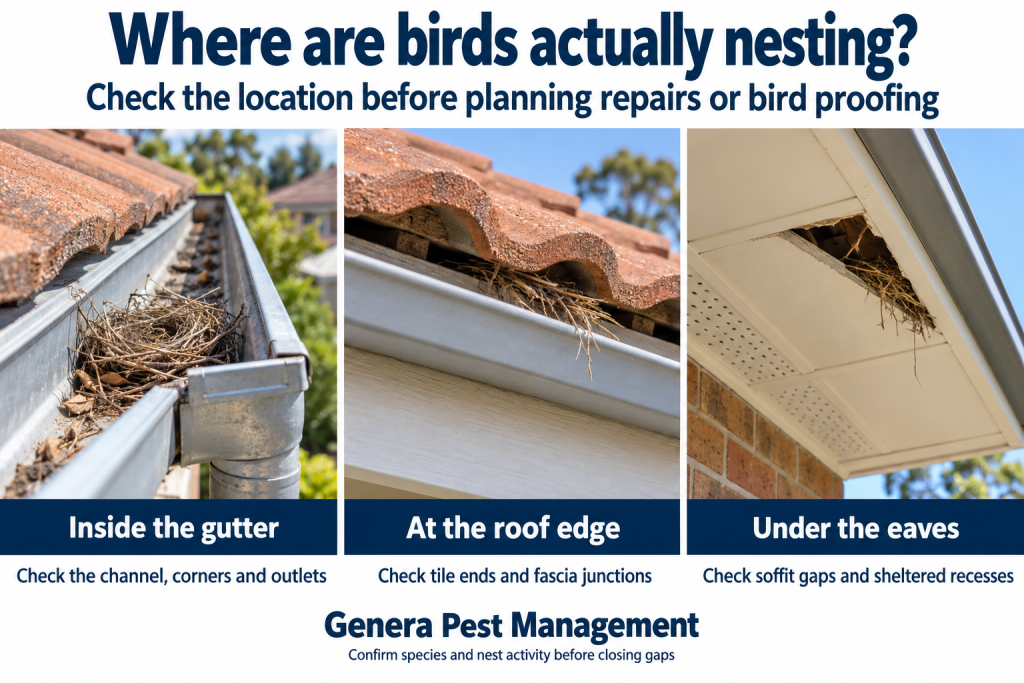
An open gutter, a concealed roof-edge gap and a sheltered ledge should not receive the same treatment.
- Inside the drainage channel: Material may collect in a corner, near an outlet or beneath an overhang. The inspection should establish whether birds placed it there or whether it fell from another nesting site.
- At the roof edge: Openings around tile ends, sheet profiles and damaged fascia junctions may provide access beside the gutter. Covering the gutter surface alone may leave these routes available.
- Under the eaves: Birds may use a sheltered recess or an opening around a soffit panel. Repairs should address the actual access point while retaining necessary ventilation.
This roofline investigation focuses on the gutter, eaves and their junctions. Evidence of activity deeper inside the building may require a separate roof-space assessment.
Why can nesting material create drainage concerns?
Nesting debris can obstruct water movement, particularly where it combines with leaves and sediment near an outlet. However, overflowing gutters can also indicate damaged components or other drainage faults.
NSW storm preparation guidance recommends regularly clearing gutters, downpipes and drains to prevent blockages. NSW Government
- Check the affected outlet: A relatively small obstruction at a downpipe opening may matter more than scattered material elsewhere. Ask the gutter contractor to assess the flow path rather than only the visible nest.
- Investigate overflow and staining: Water marks beneath an eave or repeated overflow deserve attention. Do not assume birds explain the entire problem without checking gutter condition and drainage.
- Record what happens during rain: Observations from a safe indoor or ground-level position can help locate an overflow. Never climb onto a wet roof to investigate.
Why must the bird species and nest activity be checked?
Species identification and an activity check determine what work is appropriate and when it can proceed. A nest near a house should not automatically be treated as an introduced pest bird nest.
For example, the common myna, also called the Indian myna, uses building nesting sites and may collect grass, feathers and rubbish. Appearance and location still need checking before identifying the occupant. The Australian Museum
- Obtain useful photographs: Photograph the bird’s body, head and bill from a distance. Include the roofline location so the assessor can connect the identification with the access point.
- Check for dependent young: A quiet nest is not necessarily empty. The assessment should establish whether eggs or chicks are present rather than relying on one brief observation.
- Confirm applicable permissions: Native wildlife protections may affect proposed work. Where management could harm protected native birds, seek advice from the NSW Biodiversity and Heritage Regulator about any required authorisation. Property damage does not itself provide permission. Environment and Heritage
When should removal and exclusion take place?
Removal and proofing should follow a confirmed assessment of the species, nest status and proposed method. Avoid closing openings while birds or dependent young could remain behind them.
There is no single calendar date that makes every roofline nest suitable for removal.
- Plan around actual activity: Where appropriate, work may need to wait until young are independent and the site is no longer occupied. Confirm this before the installer arrives.
- Assess urgent drainage problems separately: If water is entering the building, explain both the drainage concern and the nesting activity to the contractors. They can assess how to manage the building problem without an improvised nest disturbance.
- Coordinate the work sequence: Where removal is appropriate, arrange cleaning, repairs and exclusion together. A long gap between these steps can leave the same site available again.
Which gutter bird proofing options may help?
Suitable gutter bird proofing closes the relevant bird access route while preserving drainage, ventilation and maintenance access. Product choice should follow the inspection.
The right solution may involve a roof repair, a fitted exclusion component or a combination.
- Roof-profile barriers: Purpose-made components may suit openings beneath particular tiles or metal roof profiles. Compatibility and fitting matter because an uncovered end or junction can leave access available.
- Soffit and fascia repairs: Damaged panels and open junctions may require building repairs. Sealing every visible opening indiscriminately can interfere with ventilation or conceal an unresolved defect.
- Selected mesh or screening: Screening may suit some recesses where it can be securely installed and maintained. If bird exclusion netting is proposed, appropriate selection, installation and regular checks are essential to reduce entanglement and trapping risks. dpird.nsw.gov.au
Will gutter guards or bird spikes prevent nesting?
Neither gutter guards nor spikes should be assumed to solve every nesting problem. Their suitability depends on where the birds are landing, building and entering.
Ask the provider to explain which part of the problem the proposed system addresses.
- Gutter guards need a site-specific assessment: A leaf-screening product may leave nearby roof-edge openings accessible. Confirm how corners, ends and existing gaps will be handled.
- Spikes address selected landing surfaces: They do not close an opening behind a fascia or repair a damaged eave. A nesting access problem needs a solution that addresses access.
- Cleaning must remain practical: Any installed system should allow inspection and removal of accumulated debris. Ask how future gutter servicing will be performed.
How should bird proofing and roof repairs be coordinated?
The bird management provider and roof or gutter contractor should agree on responsibilities and sequencing before work starts. This helps prevent gaps between assessment, repairs and final proofing.
For example, fitting exclusion to a fascia scheduled for replacement may mean removing and reinstalling it shortly afterwards.
- Share the same scope: Mark affected outlets, entry points and repair areas on photographs. Confirm who handles nest assessment, material removal, drainage repairs and exclusion.
- Arrange suitable access: Roofline work can involve significant fall risks. SafeWork NSW prioritises avoiding work at height where possible and using appropriate controls where it is necessary. SafeWork NSW
- Check the completed junctions: After repairs, review the interfaces between old and new components. Confirm that proofing remains secure and required drainage and maintenance access remain available.
What prevents birds returning after the work?
Continued prevention depends on maintaining the repaired roofline and responding to fresh activity. Removing a nest without addressing access leaves the original opportunity available.
- Keep a location record: Retain photographs and the agreed scope. These help future contractors recognise what was installed and avoid disturbing it.
- Review after storms or roof work: Ask for checks when components have shifted or another contractor has worked nearby. A previously secure barrier may need adjustment.
- Report renewed activity early: Record the exact location and behaviour if birds return. Activity at a neighbouring recess may require a different response from a failure at the original opening.
Frequently asked questions
Can I remove a bird nest from my gutter myself?
Arrange an assessment before disturbing a suspected nest. Species, occupancy and safe access all affect the next step.
- Do not remove material containing eggs or chicks.
- Avoid reaching from a ladder to investigate a concealed roofline opening.
Does an overflowing gutter mean birds are nesting there?
No. Overflow can result from leaves, sediment, damaged components or other drainage issues.
- Look for repeated bird activity alongside the drainage symptoms.
- Arrange a gutter inspection to establish the cause rather than assuming a nest is responsible.
Will birds return after the nest is removed?
They may return if the nesting location remains accessible and suitable.
- Combine appropriate removal with repairs and exclusion.
- Monitor adjacent roofline sections for new activity.
Can gutter guards trap birds?
A poorly planned installation can close birds into a concealed area or leave hazardous gaps.
- Check occupancy before installation.
- Require the installer to explain how entrapment will be prevented and future inspections performed.
Who should I contact about birds in eaves and damaged gutters?
A bird management provider can assess activity while an appropriate roof or gutter contractor assesses building defects.
- Share photographs and previous repair details with both.
- Ask for a coordinated scope that identifies who completes each task.
Arrange a roofline bird assessment
Start with a clear assessment of the nesting location, drainage concerns and available prevention options. Genera Pest Management lists bird nest removal, gutter cleaning and bird proofing services. Ask which services suit your property and whether separate roof repairs are needed. Pest Control Company Sydney
- Book a discovery call: Explain where birds are active and whether you have noticed overflow or damaged eaves.
- Prepare your photographs: Include the affected roofline and any visible bird activity, taken from a safe position.
Call 1300 149 549 or book a discovery call with Genera Pest Management to discuss your next step.