
SEO title: Bird Proofing Maintenance: Checks, Repairs and Aftercare
Meta description: Learn what to check after bird proofing installation, including loose netting, damaged fixings, gaps, wildlife concerns and when to arrange repairs.
URL slug: /bird-proofing-maintenance/
Keyword phrases: bird proofing maintenance, bird netting repairs, bird spike maintenance, bird exclusion inspections, bird proofing repairs Sydney, loose bird netting, bird deterrent maintenance
Excerpt: Bird proofing needs ongoing attention to remain effective. Learn how to recognise damage, report new gaps, respond to wildlife concerns and coordinate inspections after building works.
Bird Proofing Maintenance: What to Check After Installation
Bird proofing maintenance helps keep an installed system secure, effective and safe for wildlife. Netting, spikes and other exclusion components can develop problems after storms, cleaning, building repairs or everyday maintenance access.
You may notice a loose edge, fresh droppings or birds returning to a previously protected area. These signs deserve investigation, but they do not always mean the whole installation needs replacing.
For Sydney homeowners, strata managers and facilities teams, the practical approach is to keep installation records, make safe observations and arrange suitable inspections when conditions change. Early reporting gives the repair contractor useful information before a small defect becomes a recurring access problem.
What should you receive after bird proofing installation?
Ask for a clear record of the protected areas, installed products and maintenance requirements. This gives you a reference for future checks and helps other contractors avoid damaging the system.
Confirm these items with the installer rather than assuming every quotation includes them.
- Installation photographs and locations: Keep images showing completed edges, corners and access openings. These make later changes easier to identify, particularly across several balconies or roof sections.
- Product and aftercare information: Request the relevant manufacturer instructions and any warranty conditions. Clarify which tasks need a trained contractor and whether cleaning products or methods have restrictions.
- Named responsibilities: Record who receives defect reports and authorises repairs. In managed buildings, residents and maintenance teams should know where to send observations.
Which signs suggest the system needs attention?
New gaps, displaced components and birds entering a protected area are reasons to arrange assessment. Compare observations with the installation record where possible.
Fresh activity should be described precisely because birds landing nearby present a different problem from birds passing through damaged proofing.
- Changes in alignment: Look for lifting spike bases, detached edges or components hanging below their original position. Photograph the location from a safe viewpoint without pulling or testing anything.
- Renewed bird access: Record whether birds are outside, behind or beneath the system. Note the route they use and whether they carry nesting material.
- New fouling patterns: Fresh droppings beneath a previously protected ledge may indicate renewed use. Check the area above because birds may be occupying a neighbouring surface.
What should bird netting inspections cover?
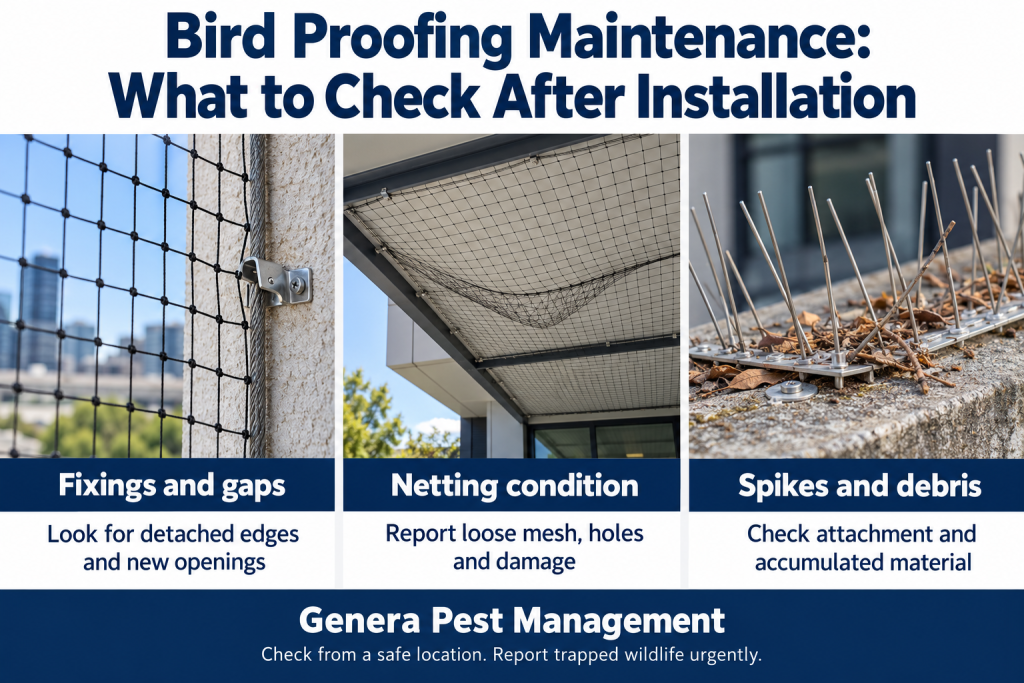
Bird exclusion inspections should assess the net, its perimeter, supporting components and access closures. A net can appear intact across its centre while leaving an opening at an edge.
NSW guidance explains that netting’s effectiveness and welfare outcomes depend on appropriate installation, maintenance and checking. dpird.nsw.gov.au
- Loose or damaged mesh: Report holes, broken strands and sections that have changed shape. The contractor should establish whether damage is isolated or indicates a wider problem.
- Perimeter gaps: Check visible junctions around walls, beams and service penetrations. Openings beside the net can undermine exclusion even when the mesh itself remains undamaged.
- Access panels and closures: Confirm that designated openings have been properly closed after servicing. Do not use an access opening if doing so could release trapped wildlife into another enclosed area.
Why do damaged fixings require assessment?
A damaged fixing may affect both the exclusion system and the surface supporting it. Reattaching a loose component without investigating the cause may leave the same weakness in place.
The repair should suit the installed system and building material.
- Check the supporting surface: Crumbling masonry, deteriorated timber or peeling coatings may need building repairs first. Ask the contractor whether the original attachment location remains suitable.
- Assess connected components: A displaced anchor or bracket may affect adjacent sections. The inspection should consider the surrounding installation rather than only the most obvious defect.
- Avoid improvised tensioning: Do not tighten support wires or add household ties yourself. Ask the repairer to follow the relevant system specification and assess the resulting loads.
What does bird spike maintenance involve?
Bird spike maintenance involves checking attachment, condition, coverage and accumulated debris. Cleaning alone will not resolve a detached strip or an unsuitable installation.
For example, Bird Barrier’s spike specifications call for checking poor adhesion, repairing defects and removing debris that remains within the product. Follow the instructions for your particular system. Bird Barrier
- Inspect the bases: Report strips lifting away from the surface or moving out of alignment. A contractor should assess the attachment and underlying surface before refitting them.
- Review coverage: Missing sections or gaps between strips can leave landing opportunities. Ask whether the existing arrangement still suits the surface and bird activity.
- Arrange appropriate cleaning: Leaves, fouling and nesting debris may need removal. If material appears to contain an active nest, seek assessment before disturbing it.
What should you do if wildlife is trapped?
Treat trapped or entangled wildlife as an urgent issue. Contact an appropriate wildlife rescue provider or veterinarian for advice and notify the installer or building manager.
NSW guidance cautions that untrained rescue attempts can injure both the animal and the person responding. Environment and Heritage
- Provide the exact location: Explain the animal’s position, apparent condition and available access. Photographs taken safely can help responders understand the situation.
- Keep people and pets away: Reduce disturbance while following the responder’s instructions. Do not climb, pull on the net or attempt to handle bats or flying-foxes.
- Investigate after the response: Arrange assessment of the entry route and damaged components before normal operation resumes. The animal’s removal alone does not resolve the cause.
How often should bird proofing be checked?
Separate frequent observations for wildlife and obvious defects from detailed contractor inspections. The appropriate arrangements depend on the system, site conditions and manufacturer guidance.
For exclusion netting, the NSW standard operating procedure recommends regular checks, preferably at least twice daily. These welfare checks are distinct from scheduled technical inspections. dpird.nsw.gov.au
- Agree on observable areas: Establish where checks can be made safely and who performs them. Tell the installer if parts of the system cannot be adequately viewed.
- Set a technical inspection schedule: Ask the provider to recommend intervals based on the installation and exposure. Record the reasoning rather than applying one schedule to every property.
- Add checks after significant events: Report visible changes after storms, impacts or nearby works. A routine appointment should not delay attention to an urgent defect.
How can inspections be arranged safely?
Owners and occupants should observe from safe locations and leave difficult access to appropriately equipped contractors. A photograph does not justify leaning over a balcony or stepping onto a roof.
SafeWork NSW prioritises avoiding work at height where possible and using suitable controls where elevated access is necessary. SafeWork NSW
- Use existing safe viewpoints: Ground-level observations or views through a window may reveal obvious changes. They cannot confirm the condition of every concealed fixing.
- Explain access restrictions: Tell contractors about locked roofs, tenancy access and operating hours. This helps them plan a meaningful inspection.
- Coordinate occupied areas: Where work occurs above entrances or shared spaces, agree on access controls. Include building management in arrangements affecting residents, staff or visitors.
What changes after building works need checking?
Roofing, painting, façade cleaning and equipment servicing can alter a previously functioning installation. Arrange a review whenever work affects proofing or the surfaces supporting it.
A section removed for access should have an agreed reinstatement process.
- Brief contractors beforehand: Show them the system locations and designated access points. Specify who may remove or alter components.
- Check interfaces afterwards: Review areas around new pipes, cables, flashings and replacement panels. Changed building details may create openings that did not exist previously.
- Confirm reinstatement: Ask who checked the completed work and whether photographs are available. Do not assume temporary removal automatically included correct replacement.
What should a defect report and repair scope include?
A useful report identifies the location, observed change and urgency. A useful repair scope explains the cause, proposed work and how completion will be checked.
This makes bird netting repairs and other maintenance easier to assess and authorise.
- Document observations: Include the date, photographs and whether wildlife or renewed access is involved. Mention recent storms, cleaning or building works.
- Clarify the proposed repair: Ask whether the work covers damaged components, supporting surfaces and access costs. Confirm any separate cleaning or building repairs.
- Record completion: Retain repair photographs and updated maintenance instructions. If birds return, these records help distinguish repeat damage from a different access route.
Frequently asked questions
Does bird proofing need maintenance if it still looks intact?
Yes. Visible appearance alone may not reveal concealed fixing problems or an opening at a junction.
- Follow the installer’s aftercare guidance.
- Arrange assessment when activity or building conditions change.
Can loose bird netting be repaired?
Sometimes, but the cause and extent of damage need assessment first. Local damage and widespread deterioration require different responses.
- Ask whether supporting components also need attention.
- Avoid pulling the net tight or applying improvised patches.
Can I clean bird spikes myself?
Only undertake tasks that are safely accessible and consistent with the product instructions. Elevated or contaminated areas may require professional cleaning.
- Avoid bending or dislodging components.
- Seek assessment before disturbing suspected active nesting material.
Should proofing be inspected after roof repairs?
Yes, where the works could affect the installation. New gaps or incomplete reinstatement can compromise protection.
- Notify the bird management provider before work begins.
- Agree who checks the affected sections afterwards.
Does renewed bird activity mean the installation has failed?
Not necessarily. Birds may be using an adjacent surface outside the original protected area.
- Record exactly where birds land or enter.
- Request reassessment before authorising replacement.
Arrange bird proofing maintenance for your property
A clear maintenance plan helps you identify changes, organise repairs and protect the value of the installed system. Genera Pest Management offers bird proofing services; contact the team to discuss assessment of your existing installation and suitable next steps. Pest Control Company Sydney
- Share your records: Provide installation photographs, product details and recent defect reports.
- Discuss the required scope: Confirm inspection access, proposed repairs and future checking arrangements.
Call 1300 149 549 or book a discovery call with Genera Pest Management to discuss your bird proofing maintenance needs.