
A useful bird management case study in Sydney should explain what happened, how the work was assessed and what the results actually demonstrate. Property managers need more than an impressive headline when deciding whether a similar approach could suit their building.
Genera Pest Management’s published Randwick hotel project provides a practical example. It also highlights an important distinction: completing a control program, installing exclusion and confirming lasting prevention are separate achievements that require their own evidence.
This case review separates the documented project details from recommendations for assessing performance. The aim is to help commercial property managers understand the result and ask better questions about their own bird problems.
What does the documented project establish?
The published account describes a staged management program at a multi-storey hotel. The following table brings together the principal project details.
- Property confidentiality: The hotel’s identity and street address are withheld. Commercial case studies can explain relevant conditions without disclosing a client’s precise location.
- Evidence boundaries: The figures below are reported by Genera. They are not an independent audit or a prediction for another building.
| Project detail | Published information |
|---|---|
| Location and property | Multi-storey hotel, Randwick NSW |
| Initial activity | Established feral pigeons around exterior and rooftop areas, with extensive fouling |
| Assessment | Resting locations, flight paths, feeding behaviour, access points and surrounding conditions |
| Approach | Assessment, one week of conditioning, then active trapping |
| Attendance | Daily servicing |
| Overall duration | Approximately four weeks |
| Recorded removal | More than 80 pigeons |
| Final observation | No pigeons observed occupying the building |
| Recommendations | Professional cleaning, routine inspections and ongoing monitoring |
The account was published on 10 August 2026. Publication is not confirmation of the work dates. Pigeon Control Case Study
Why does understanding the initial problem matter?
The starting condition determines whether a result is meaningful. A project should connect its objective with a clearly described problem rather than simply counting completed visits.
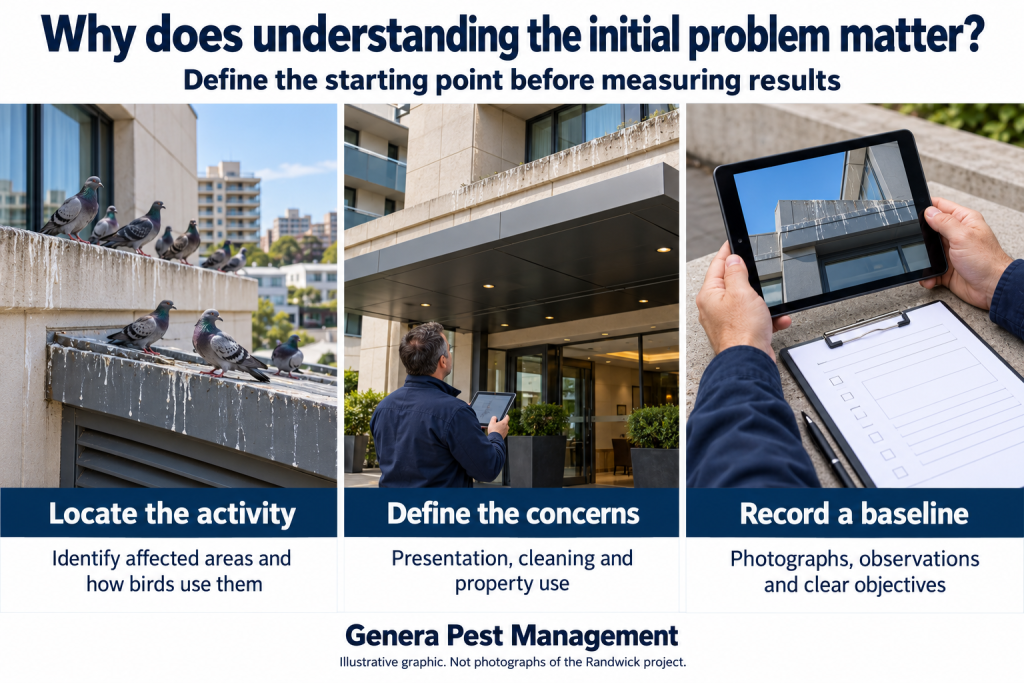
For managers, the most useful question is: what needs to change at this property?
- Define the affected areas: A building-wide occupation problem differs from occasional landing on one awning. Marking locations helps keep the assessment, quotation and completion review aligned.
- Separate concerns from measurements: Appearance, cleaning workload and guest experience may influence a decision. Claims that these improved should ideally have their own supporting records.
- Establish a baseline: Before work, agree what will be recorded and how observations will be made. A removal total alone does not establish the original population size.
How should assessment guide the chosen approach?
Assessment should explain why a particular method fits the birds’ use of the property. The reasoning matters because similar-looking buildings can present different management conditions.
The practical lesson is to investigate before specifying equipment.
- Connect observations with decisions: Ask how the identified activity influences equipment placement or proposed protection. The recommendation should be understandable without relying on technical sales language.
- Record uncertainty: Concealed spaces, inaccessible roofs and variable activity can limit an inspection. These limitations should remain visible when the result is reviewed.
- Consider alternatives: Request an explanation of suitable options and their limitations. A documented choice is more useful than assuming the same method suits every commercial site.
What constraints need consideration at a hotel?
Access, occupancy and operational requirements should shape the work plan. The available account does not identify the project’s precise access equipment or working-hour arrangements.
These are therefore questions for comparable projects, rather than additional claims about this hotel.
- Protect occupied areas: Agree how guests, deliveries and staff movements will be managed around the work. Identify which areas require restricted access.
- Plan elevated access: SafeWork NSW requires fall risks to be managed through an appropriate hierarchy of controls. A rooftop location calls for a considered access plan, including safe servicing arrangements. SafeWork NSW
- Name the decision-makers: Building management and contractors need clear responsibilities. Delayed access or unclear authority can interrupt an otherwise well-planned program.
What should customers understand about trapping and welfare?
Trapping requires specialist planning and appropriate care of captured birds. It should not be described as automatically non-lethal or as relocation unless those outcomes are documented.
NSW pest-bird guidance addresses trap inspections, protection from exposure, non-target birds and humane euthanasia of captured pest birds. dpird.nsw.gov.au
- Ask about the complete process: A customer should understand what happens after capture. The word “humane” does not, by itself, describe the birds’ eventual disposition.
- Check responsibilities: Establish who undertakes inspections and responds if conditions change. Animal welfare arrangements belong in the management plan.
- Avoid assumptions about this project: The public account does not provide a detailed disposition record. It would be inaccurate to add a release location or claim every captured bird was relocated.
What do the measured results demonstrate?
The recorded capture total and final inspection observation provide different types of evidence. One records management activity; the other records conditions at a particular inspection.
Together they support a completion finding, but they do not establish permanent prevention.
- Interpret totals accurately: Captures measure birds removed during the program. Without a verified starting count, they cannot establish a precise percentage reduction.
- Define the inspection finding: An observation applies to the areas, timing and conditions of that inspection. It should not become an unlimited claim that birds can never return.
- Measure other benefits separately: Reduced complaints, lower cleaning costs and improved customer satisfaction need supporting records. They should not be presented as measured outcomes merely because bird activity changed.
Which photographs would strengthen the case study?
Authenticated site photographs would help readers understand the starting conditions, work locations and completion findings. They should support the records rather than substitute for them.
Original dated project photographs were not available for this review.
- Before photographs: Use genuine images showing affected locations and identifiable building features. Captions should explain what is visible without diagnosing hidden conditions.
- Progress photographs: Include relevant equipment or work areas where client permission allows. Record the date and location so the image can be connected with a service visit.
- Completion photographs: Repeat earlier viewpoints where practical. A clean surface photograph alone cannot prove that bird occupation has ceased.
Any generated illustration used alongside this article should be labelled as illustrative. It should not be presented as photographic evidence of the Randwick project.
What follow-up dates should be recorded?
A complete project record should distinguish attendance dates, the completion inspection and later monitoring. Exact calendar dates were not available in the public account.
Relative duration helps explain a program, but it cannot replace dated follow-up evidence.
- Retain service dates: Each attendance should be traceable to the work performed and observations made. This allows managers to understand how decisions developed.
- Identify the completion date: Record when the outcome was assessed and which areas were checked. Keep this separate from the article’s publication date.
- Document later reviews: Subsequent inspections can establish whether the result persisted. Until those records are available, avoid claims about particular months or seasons of continued success.
Was this a bird exclusion project?
The available evidence supports a trapping-based management case study. It does not substantiate an installed netting, wire or spike system.
That distinction matters when customers compare pigeon proofing results with population-management outcomes.
- Describe installed work precisely: A bird exclusion project should identify the protected area and installed system. Neither should be added to this case without supporting records.
- Separate advice from completion: A recommendation becomes completed work only when it is authorised, undertaken and recorded. The same applies to cleaning and building repairs.
- Assess future prevention independently: If proofing is proposed later, evaluate its suitability and maintenance needs. NSW guidance recognises that exclusion netting requires correct application and regular checking. dpird.nsw.gov.au
Frequently asked questions
How can I tell whether a bird control case study is credible?
Look for a defined problem, explained method and clearly bounded results.
- Check whether photographs and dates support the account.
- Distinguish reported findings from independently verified evidence.
Does a successful project guarantee the same result elsewhere?
No. Another property requires its own assessment and agreed objectives.
- Compare building conditions and bird behaviour.
- Ask how success will be measured at your site.
Is removing birds the same as bird proofing?
No. Removal and physical exclusion address different parts of management.
- Ask exactly which works are included.
- Request evidence of any claimed installation.
Why are follow-up inspections important?
They show what happens after the initial program ends.
- Record new activity in consistent locations.
- Use findings to guide any further action.
Should a case study include before-and-after photographs?
Genuine photographs are useful when accurately dated and captioned.
- Use comparable viewpoints where possible.
- Do not treat stock or generated images as project evidence.
Discuss a documented plan for your property
Ask Genera Pest Management to assess your bird problem and explain suitable options, proposed records and follow-up arrangements.
- Share the history: Provide photographs, previous reports and details of recurring activity.
- Agree on the outcome: Clarify the scope, completion checks and ongoing responsibilities before work begins.
Call 1300 149 549 or book a discovery call with Genera Pest Management to discuss your commercial bird management needs.