
Choosing a bird control company in Sydney starts with finding a provider who can explain your bird problem before recommending a solution. The proposal should connect the species, activity and building conditions with appropriate works and ongoing care.
You want to stop recurring fouling, nesting or building access without paying for a system that misses the cause. Comparing suppliers becomes easier when each answers the same questions and prices a clearly defined scope.
Whether you manage a home, strata complex or commercial property, look for evidence of relevant work, practical inspection findings and transparent responsibilities.
What experience should a bird control company demonstrate?
Look for experience with comparable birds, buildings and access conditions. General pest control experience alone does not explain whether a provider can deliver your particular project.
A balcony enclosure, warehouse roof and heritage façade present different installation challenges.
- Ask about similar properties: Request examples involving comparable surfaces, heights and operating constraints. Ask what made those projects difficult and how the provider addressed those conditions.
- Identify the proposed team: Confirm who will assess, install and supervise the work. If subcontractors are involved, ask which tasks they perform and who remains your main contact.
- Discuss recurring problems: An experienced bird management specialist should explain how they investigate unsuccessful previous work. Listen for questions about access, food sources and bird behaviour.
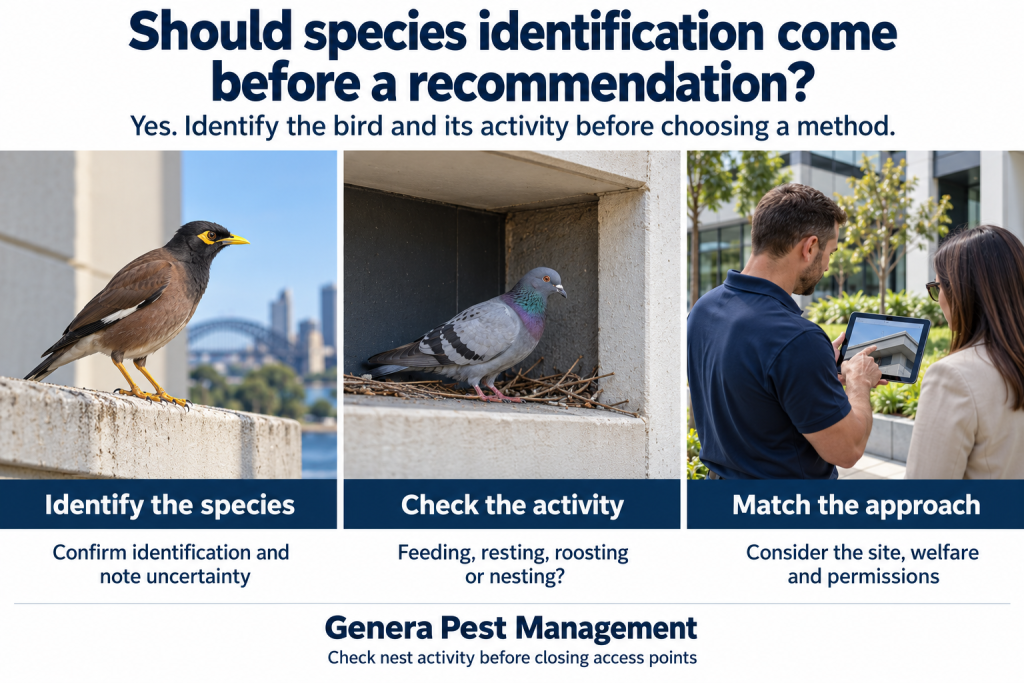
Should species identification come before a recommendation?
Yes. The provider should establish which birds are involved and whether they are feeding, resting, roosting or nesting before selecting a method.
Where proposed work could harm protected native birds, applicable permissions need checking. NSW provides a licensing process for certain management of protected native animals; property damage does not itself authorise control. Environment and Heritage
- Ask how identification is confirmed: Photographs and observations may help, but uncertainty should be acknowledged. Avoid accepting a confident identification based only on droppings or noise.
- Discuss nest activity: Ask how eggs, chicks and concealed occupants will be checked before exclusion. The response should address timing and preventing entrapment.
- Request a reasoned method: The provider should explain why the proposed system suits the identified behaviour. A product recommendation without an assessment leaves important questions unanswered.
What should a useful site inspection establish?
A useful inspection identifies the affected areas, likely causes, installation constraints and any limitations on the assessment. These findings should inform the quotation.
Photographs can support an initial discussion, but concealed openings and difficult fixing surfaces may need closer investigation.
- Map the problem: Ask the assessor to distinguish active locations from old fouling or occasional landing sites. Marked photographs can make a complex proposal easier to understand.
- Review building interfaces: Fixing surfaces, drainage, ventilation and maintenance access may affect system choice. Identify repairs that need a separate roofing, building or solar contractor.
- Record uninspected areas: Ask which locations were inaccessible and how that affects the price or recommendation. Any provisional assumptions should be clear before you accept.
Which insurance and credentials should you check?
Request current insurance evidence and credentials relevant to the actual work. A broad claim of being “fully licensed and insured” needs enough detail to verify.
NSW EPA pest management technician licensing relates to pesticide work. It should not be treated as proof of competence in every bird proofing installation or access method. EPA
- Check insurance details: Request current public liability documentation and workers compensation evidence where applicable. Confirm the insured business matches the contracting entity and query whether the proposed activities are covered.
- Match credentials to tasks: Ask about product training, access competencies and any licences required for the proposed methods. Verify pesticide authorisation if chemical treatment forms part of the scope.
- Clarify subcontractor arrangements: Establish who checks their insurance and qualifications. Your agreement should identify responsibility for their work and any resulting defects.
How should a supplier demonstrate safe access capability?
The supplier should explain how the team will reach the work area, protect others and arrange future servicing. Access should be considered before the quotation is finalised.
SafeWork NSW prioritises avoiding work at height where possible and selecting appropriate controls where elevated work is necessary. SafeWork NSW
- Discuss the proposed approach: Ask whether the price allows for required access equipment and site arrangements. A statement that workers “use harnesses” does not explain the complete plan.
- Identify operational restrictions: Tell suppliers about entrances, loading docks, tenants and restricted working hours. Confirm who coordinates any closures or exclusion areas.
- Consider later repairs: Ask how installed components will be inspected and maintained. Difficult access can affect ongoing costs as well as installation pricing.
What must a written bird control quote include?
A useful quote defines where work will occur, what will be installed and what remains outside the agreement. This lets you compare the same outcome across suppliers.
Use the following checklist when reviewing proposals.
- Check the boundaries: Identify every included ledge, opening, roof section or enclosure. Ask suppliers to explain differences in coverage.
- Resolve allowances: Confirm whether access, cleaning and preliminary repairs are fixed inclusions or estimates. Agree how additional work will be approved.
| Comparison item | What to request |
|---|---|
| Assessment | Species, behaviour and inspection limitations |
| Protected areas | Measurements or marked photographs |
| Proposed system | Product details, fixing approach and rationale |
| Preparation | Cleaning, nest assessment and surface repairs |
| Access | Equipment, permissions and operational arrangements |
| Price | GST, allowances, exclusions and payment stages |
| Completion | Agreed checks, photographs and handover information |
| Aftercare | Inspection duties, servicing and warranty terms |
What evidence of completed work is worth reviewing?
Look for attributable project examples that explain the problem, method and outcome. Photographs become more useful when the supplier can describe what they show.
Online reviews can indicate communication and reliability, but they provide limited evidence of installation quality.
- Request comparable examples: Ask when the work was completed and whether follow-up information is available. Respect client confidentiality while seeking enough detail to assess relevance.
- Distinguish results from promises: A successful project demonstrates experience in that setting. It cannot guarantee the same outcome for a different building.
- Read case studies critically: Genera’s published Randwick hotel bird management case study describes assessment, servicing and a final inspection. Use such examples to ask how a provider would adapt its approach to your property. Pigeon Control Case Study
What maintenance arrangements should be agreed?
Maintenance responsibilities should be discussed before installation. Ask how owners will observe the system, report defects and arrange professional inspections.
NSW guidance makes clear that netting requires appropriate maintenance and regular checking to reduce wildlife entanglement and trapping risks. dpird.nsw.gov.au
- Request written aftercare: Confirm the relevant product instructions and checking arrangements. Distinguish safe routine observations from technical inspections requiring specialist access.
- Clarify response arrangements: Ask who receives reports of loose components, gaps or trapped wildlife. Understand whether call-outs and repairs incur additional charges.
- Plan for building works: Establish how painters, roofers and equipment technicians should work around the installation. Agree who checks any removed or disturbed components.
How should you compare warranty terms?
Compare what the warranty covers, how claims work and which conditions apply. A longer advertised period does not necessarily provide broader protection.
The ACCC distinguishes voluntary warranties from automatic consumer guarantees. Where consumer guarantees apply, a warranty cannot remove them. ACCC
- Separate the promises: Clarify coverage for materials, workmanship and any stated performance outcome. Ask whether birds using adjacent untreated areas fall outside the agreed protection.
- Read exclusions: Check conditions involving maintenance, storms, building movement and third-party alterations. Ask how these conditions relate to your property.
- Understand claim costs: Confirm the reporting process and whether assessment, labour or access equipment may be chargeable. Obtain the terms before paying a deposit.
Frequently asked questions
How do I compare pigeon control services fairly?
Give each supplier the same description, photographs and access information. Compare coverage and responsibilities alongside price.
- Ask each provider to explain its recommendation.
- Resolve differences in cleaning, access and aftercare before choosing.
Should I choose the cheapest bird control quote?
Choose a proposal that adequately addresses the assessed problem within your budget. A lower price may reflect a narrower scope.
- Check excluded areas and provisional allowances.
- Ask what future inspections and repairs could involve.
Can a bird proofing installer guarantee birds will never return?
Treat absolute promises cautiously. Building changes, damage and activity outside the protected area can affect results.
- Request a defined protection area and written terms.
- Ask how renewed activity will be investigated.
Is a site visit always necessary before a quote?
Photographs may support an estimate, but some conditions need inspection before a reliable installation scope can be confirmed.
- Ask whether the price is provisional.
- Identify what must be checked before work proceeds.
What should I prepare before contacting a provider?
Gather the property address, photographs, activity history and access restrictions. Include details of earlier deterrents or repairs.
- Photograph birds and affected areas from safe locations.
- Explain your priorities, such as protecting stock or keeping a balcony usable.
Discuss your property with Genera Pest Management
Start with an assessment discussion, then review the proposed scope and aftercare before authorising work. Genera Pest Management offers bird proofing services for residential and commercial properties. Pest Control Company Sydney
- Explain the problem: Share where birds are active and how the issue affects your property.
- Request clear recommendations: Discuss suitable methods, access requirements and ongoing responsibilities.
Call 1300 149 549 or book a discovery call to discuss your bird management needs