
Strata bird control in Sydney works best through a coordinated response that brings together resident reports, building assessment, property responsibilities and approved works. The committee should establish where birds are active, which areas are affected and who has authority to approve the proposed response.
A complaint about one balcony may reveal activity across several levels, roof sections or shared entrances. Separate residents buying different deterrents can leave gaps, complicate maintenance and produce inconsistent results.
The practical starting point is one reporting process and a clear assessment brief. From there, the scheme can decide what work is justified and how to organise it.
Why does a strata building need a coordinated response?
Birds can use several parts of a building, so individual balcony treatments may address only part of the problem. Coordination helps identify connections between complaints.
- Shared activity: Birds may rest on common property while fouling private outdoor areas. Investigating both locations gives the assessor a clearer picture.
- Consistent coverage: Separate installations can leave untreated spaces between protected areas. A coordinated scope makes those boundaries easier to understand.
- Efficient planning: Assessment, access and resident communication can be organised together. Any cost benefit should be confirmed through quotations rather than assumed.
The objective is to manage documented problems across the relevant areas. It does not require treating every balcony simply because birds have been reported somewhere in the building.
How should residents report bird problems?
Use a consistent reporting process that records the location, activity and impact. Clear reports help distinguish recurring patterns from isolated sightings.
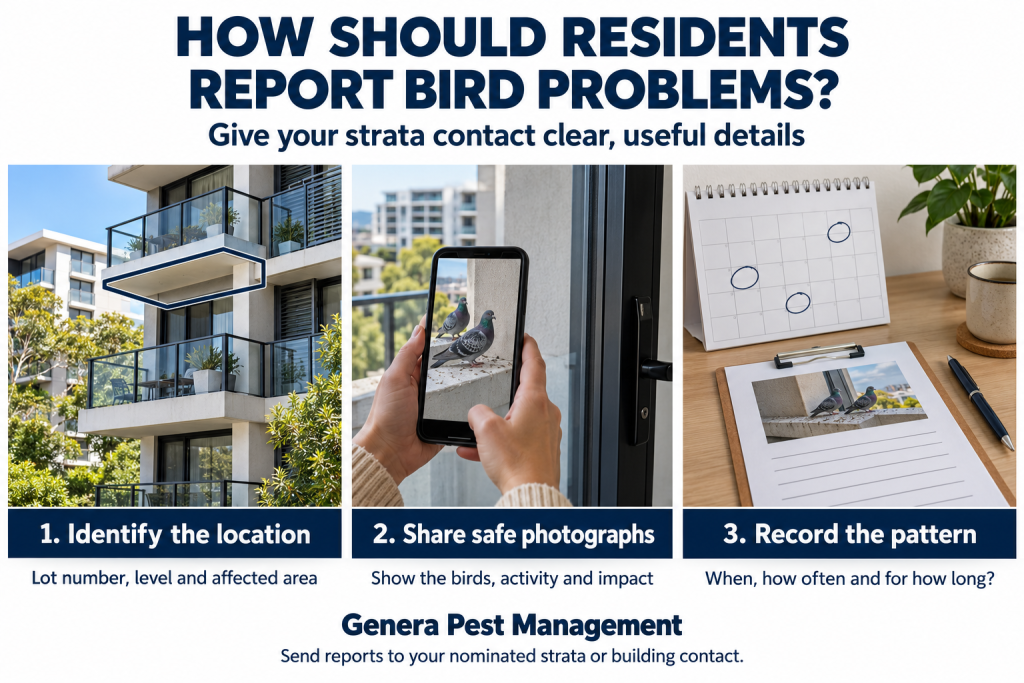
- Location: Request the lot number, building elevation and affected area. Include whether the activity is on a balcony, roof, ledge or shared entrance.
- Evidence: Ask for dated photographs taken safely and a brief description of what birds are doing. Residents should avoid approaching nests or reaching outside railings.
- Timing: Record when activity occurs and how long it has continued. Note previous cleaning, deterrents or repairs.
Nominate one contact to collate reports. This may be the strata manager, building manager or an agreed committee representative.
Is the affected area common property or private property?
Check the strata plan and applicable by-laws before allocating responsibility. Physical access from an apartment does not establish ownership of the adjoining structure.
- Separate components: Balcony surfaces, structural elements, doors and fixtures may have different responsibilities. Identify exactly what needs cleaning, repair or alteration.
- Review existing arrangements: Earlier works or common property rights by-laws may affect maintenance obligations. Request the relevant records.
- Confirm uncertainty: Ask the strata manager to explain the position. Obtain appropriate specialist advice where the documents do not resolve it.
NSW guidance states that the owners corporation maintains common property while owners maintain their own property. It directs schemes to their strata plan and by-laws when responsibility is unclear. NSW Government
What should the inspection brief include?
The inspection brief should describe the reported activity, relevant building areas and practical constraints. Give the contractor enough information to investigate the building rather than one complaint in isolation.
- Consolidated reports: Provide photographs, affected locations and previous treatment details. Mark recurring activity on a building plan where available.
- Access requirements: Identify roof access, locked areas and apartments that may need entry. Confirm authorisation arrangements before attendance.
- Decision requirements: Explain what the committee needs for review, including findings, photographs and a clearly defined proposal. Confirm any inspection fees.
Ask the assessor to distinguish confirmed findings from inaccessible or uncertain areas. A preliminary view should not be presented as a complete inspection of concealed spaces.
What approvals may be needed for bird proofing?
Approval depends on the work and the scheme’s governance arrangements. Routine maintenance and new alterations to common property should not automatically follow the same pathway.
- Clarify authority: Establish whether the committee can approve the proposed work or whether an owners corporation decision is required. Check delegated authority and spending restrictions.
- Assess alterations: Fixings, changes to external appearance or work affecting waterproofing need appropriate consideration. Ask the strata manager to identify the process before installation.
- Record conditions: Keep approvals, accepted plans and maintenance arrangements with the scheme’s records. Ensure the final installation matches what was approved.
NSW guidance distinguishes committee decisions from matters reserved for the owners corporation. It also explains that some changes affecting common property may require a by-law. NSW Government
How should appearance and building compatibility be considered?
Review the proposed system against the building’s appearance, materials and servicing requirements. A discreet installation still needs suitable coverage and attachment.
- Visual information: Request photographs of comparable work, product samples or marked images. These make appearance easier to assess than a product name alone.
- Fixing locations: Ask how supports attach and whether building components need repair first. Clarify any implications for waterproofing or existing warranties.
- Maintenance access: Identify lights, drainage and equipment behind the proposed protection. Access openings should suit the tasks contractors need to perform.
Scheme by-laws can regulate balconies and renovations, so check the applicable requirements. A system accepted in another building is not automatically approved in yours. NSW Government
What should residents be told before work begins?
Residents need practical information about the work, access and any actions required from them. Communication should explain the purpose without overstating risks or promising complete bird removal.
- Schedule: Provide the expected work dates, affected areas and contact for changes. Explain whether weather or access could alter the program.
- Preparation: State whether furniture, pets or balcony items need moving. Instructions should come from the agreed work plan.
- Restrictions: Explain temporary closures, noise or entry arrangements. Tenanted apartments may require coordination through owners and managing agents.
Give residents a way to raise access concerns early. Avoid circulating personal complaint details when a summary of locations and activity is sufficient.
How can installation and cleaning be coordinated?
Plan the sequence so inspection findings, nest management, cleaning and installation support each other. Confirm which contractor is responsible for every component.
- Occupancy checks: Nesting activity can affect timing. Do not instruct residents to remove nests or seal openings ahead of the agreed assessment.
- Cleaning scope: Specify affected surfaces and disposal arrangements. Confirm whether cleaning is included or requires a separate contractor.
- Related repairs: Roof defects or work near electrical equipment may need another trade. Establish the order before appointments are booked.
If staging is necessary, record what remains unprotected between stages. Ask how that affects expected results and subsequent access costs.
What should the committee compare in quotations?
Compare equivalent coverage, inclusions and aftercare rather than the headline total alone. Different methods may protect different parts of the building.
- Defined scope: Check locations, materials, fixing arrangements and access equipment. Identify excluded areas clearly.
- Responsibilities: Confirm who handles approvals, resident access, cleaning and specialist repairs. Resolve gaps before accepting.
- Commercial terms: Review payment stages, warranties and maintenance charges. Agree how additional findings will be priced and authorised.
Use the scheme’s applicable procurement and approval process. Keep the selection rationale with the accepted quotation so future committee members understand the decision.
Who maintains installed bird protection?
Maintenance responsibility should be agreed and documented before installation. Avoid leaving future committees to infer obligations from who originally paid.
- Property responsibilities: Check whether the installation affects common property and whether a by-law is needed. Relevant documentation should identify ongoing obligations.
- Routine checks: Nominate who reports loose material, damage or trapped wildlife. Residents should observe only from safe positions.
- Professional servicing: Obtain inspection and repair requirements from the installer. Budget for necessary access as well as replacement components.
NSW guidance requires common property rights by-laws to address maintenance responsibility. Separately, exclusion netting needs regular checks to reduce wildlife hazards. NSW Government
How should the scheme review results?
Review the activity the project was intended to address using consistent observations. Birds remaining elsewhere nearby do not necessarily mean the protected areas have failed.
- Compare locations: Record renewed entry, fresh fouling or nesting in the agreed areas. Use completion photographs as a reference.
- Collect feedback: Ask affected residents whether the original problem continues. Request dates and evidence rather than general impressions.
- Investigate changes: Building repairs, new feeding activity or damaged protection may explain recurrence. Refer findings to the provider for review.
A coordinated reporting process remains useful after installation. It helps identify problems before residents begin making unapproved alterations.
Frequently asked questions about strata bird management
These answers clarify common committee concerns before arranging works.
Does the owners corporation always pay for balcony pigeon control?
No universal rule covers every balcony problem. Responsibility depends on the affected components, documents and proposed work.
- Check the strata plan and by-laws. Obtain clarification before allocating costs.
Can residents install their own balcony netting?
Residents should check permissions before altering the building. External appearance and common property fixings may affect approval requirements.
- Submit the design through the appropriate process. Tenants should also involve their landlord.
Can the committee approve every bird proofing proposal?
No, committee authority has limits. Some decisions are reserved for the owners corporation.
- Ask the strata manager to confirm the pathway. Record the required decision.
Should every apartment receive the same protection?
Only where assessment supports that coverage and design. Different elevations or recesses may have different conditions.
- Request a location-specific explanation. Avoid unnecessary installation.
What if birds move to another balcony?
Report the new activity for reassessment. It may reveal an untreated location or changing conditions.
- Compare it with the original scope. Avoid assuming every movement is covered by the warranty.
Organise one clear response for your building
Start with consolidated reports, confirmed responsibilities and an assessment of the relevant areas. Genera Pest Management can help your scheme discuss suitable apartment bird management options.
- Share the evidence: Provide affected locations, photographs and previous work records.
- Request a coordinated proposal: Discuss common property bird proofing, access and maintenance.
Call Genera Pest Management on 1300 149 549 or book a discovery call to discuss strata bird control in Sydney.