
Pest bird identification in Sydney starts with checking visible features, comparing reliable reference photographs and confirming uncertainty before choosing management. An Indian myna is an introduced starling relative, while the similarly named noisy miner is a native honeyeater. Likewise, a pigeon-shaped bird is not automatically a feral pigeon.
If birds are nesting around your property, you may want the problem resolved quickly. However, a mistaken identification can lead to unsuitable equipment, unnecessary disturbance or inappropriate control.
The first task is establishing which birds are present. The next is understanding whether their activity requires intervention and what response suits the site.
Why does bird identification matter before management?
Identification affects wildlife protections, equipment selection and the management options worth considering. Behaviour or location alone cannot establish whether a bird is native or introduced.
- Protection requirements: Native birds are generally protected in NSW, with limited exceptions. A bird causing inconvenience does not automatically lose that protection.
- Equipment suitability: Birds of different sizes may require different exclusion specifications. A system designed for pigeons may not exclude smaller species.
- Actual impact: Identify what the birds are doing as well as what they are. Occasional visits differ from repeated entry, nesting or fouling.
NSW guidance explains that wildlife protections have species and location-specific exceptions. Requirements should be checked against the actual circumstances. Environment and Heritage
Which features should you photograph or record?
Record several features together rather than identifying a bird from one colour, sound or behaviour. A useful photograph shows details that can be compared with a reliable species profile.
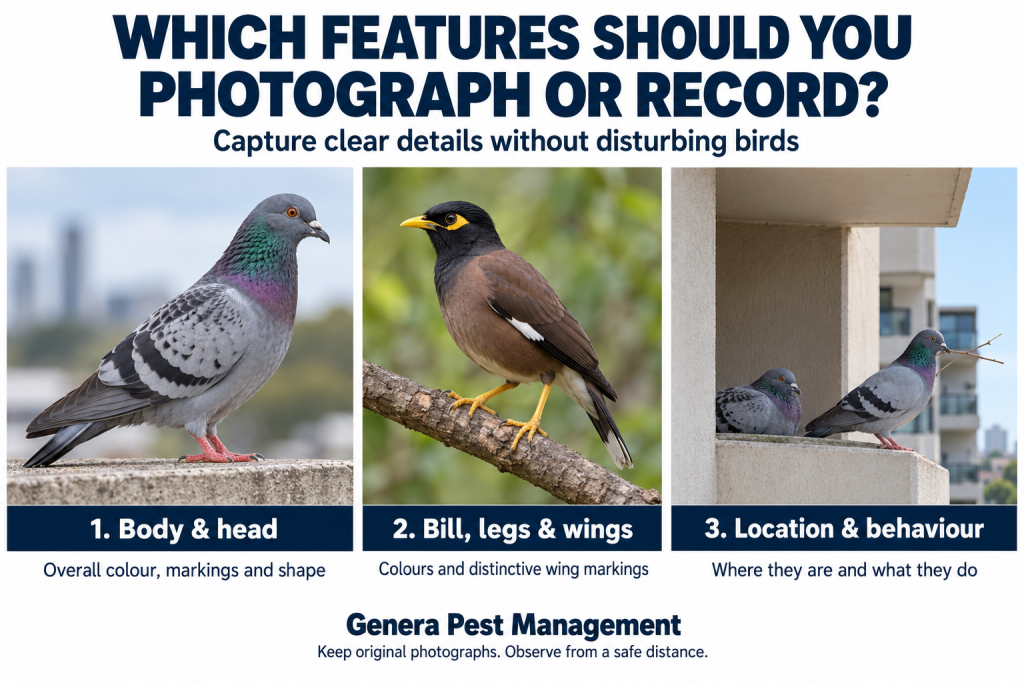
- Body and head: Note the overall colour, head markings and body shape. Backlighting can make brown or grey birds appear almost black.
- Bill, legs and wings: Record visible colours and distinctive markings. A wing patch may be clearer when the bird flies naturally.
- Context: Note approximate size, location and observed behaviour. Explain whether several species are using the area.
Take photographs from a safe position without approaching nests. Keep the original image because heavy editing or enlargement can obscure the features needed for identification.
Indian myna vs noisy miner: how do you tell them apart?
The clearest starting difference is body colour: the Indian myna is mainly brown, while the noisy miner is mainly grey. Both have yellow features around the face and legs, so those similarities can be misleading.
- Indian myna: Also called the common myna, it has a brown body and black head. Large white wing patches become conspicuous in flight.
- Noisy miner: This native honeyeater has a predominantly grey body with black crown and cheek markings. Its wings have yellow or olive edging.
- Shared features: Both can appear confident and vocal around people. Aggression does not distinguish an introduced bird from a native one.
BirdLife Australia specifically identifies this pair as commonly confused birds. They belong to different bird families despite their similar names. BirdLife Australia
| Feature | Common or Indian myna | Noisy miner |
|---|---|---|
| Origin | Introduced to Australia | Native to Australia |
| Main body colour | Brown | Grey |
| Head | Black head | Black crown and cheek markings |
| Bill and legs | Yellow | Yellow |
| Wing clue | Conspicuous white patches in flight | Yellow or olive feather edging |
| Bird family | Starling family | Honeyeater family |
Reference photo comparison: View the Sydney Olympic Park myna and miner comparison, which includes photographs of both species. Compare several features rather than matching only the yellow bill. Sydney Olympic Park
How can you recognise a feral pigeon?
Feral pigeons are free-living populations of the rock dove, but their plumage can vary considerably. A familiar grey pattern is useful without being universal.
- Typical appearance: Many show a grey body, iridescent neck feathers and dark wing bars. Other colour patterns mean identification should not rely on grey plumage alone.
- Building use: Rock doves commonly use artificial ledges and roof spaces. A bird on an apartment building still needs identification rather than assumption.
- Reference photographs: Compare the whole bird with an authoritative profile. Include its head, wings and body proportions where possible.
The Australian Museum identifies the rock dove as the feral pigeon and describes its close association with urban settlement. Its rock dove profile includes a reference photograph. The Australian Museum
Why should pigeon-shaped birds be checked carefully?
Sydney also has native pigeons and doves, so “pigeon” is not a sufficient identification. Recognisable features can help distinguish them from feral birds.
- Crested pigeon: Look for the conspicuous thin black crest. The body is largely grey-brown, with barred wings and glossy patches.
- Partial views: A bird seen briefly through foliage may conceal its distinguishing features. Wait for a clearer observation rather than filling in missing details.
- Mixed groups: Do not assume every bird feeding in one place belongs to the same species. Check individual birds where the proposed management could affect them.
Compare the Australian Museum’s crested pigeon photographs with its rock dove profile. The crest is a useful clue, but the complete identification still matters. The Australian Museum
How do common starlings change appearance?
Common starlings vary with age and season, making a single photograph an incomplete reference. An adult and a juvenile may look noticeably different.
- Adult plumage: Adults can appear dark and glossy with green or purple reflections. Pale spotting can be prominent in fresher plumage.
- Seasonal differences: Bill colour and the visibility of spots change. Do not reject an identification solely because one feature differs from a reference image.
- Young birds: Juveniles are dull grey-brown. Their appearance can be less distinctive than the familiar glossy adult.
The Australian Museum documents these changes in its common starling profile, including reference photographs. Starlings are introduced birds established across eastern and southeastern Australia. The Australian Museum
Does nuisance behaviour identify a pest species?
No, noise, confidence or territorial behaviour does not establish whether a bird is introduced or legally unprotected. Native birds can also defend territory or occupy buildings.
- Separate identity from behaviour: Record the species evidence and the activity as different findings. Neither should substitute for the other.
- Describe the concern: Explain whether birds enter occupied rooms, contaminate surfaces or obstruct planned work. This defines the problem needing assessment.
- Avoid reputation-based decisions: A bird being described as aggressive or common is not sufficient grounds for control. Ask what management is appropriate for the confirmed species.
The Indian myna and noisy miner comparison demonstrates this distinction. Both can behave aggressively, despite their different origins and biological relationships. BirdLife Australia
What should you do when identification is uncertain?
Pause management that could affect birds and seek a clearer assessment. Uncertainty should be stated openly rather than converted into a confident guess.
- Collect better evidence: Take additional photographs when the bird is naturally visible. Note which details remain unclear.
- Use authoritative comparisons: Compare museum or recognised bird organisation profiles. Include juvenile and seasonal appearances where relevant.
- Arrange assessment: Explain whether the birds are nesting or entering concealed areas. Further observation may be needed before a recommendation.
Do not trap a bird simply to identify it. Avoid disturbing a nest to obtain photographs of eggs or young.
How does identification change management decisions?
The confirmed species helps determine permissions, timing and suitable prevention measures. The final approach must also account for occupancy and building conditions.
- Nest management: Check for eggs and dependent young before removal or exclusion. Ask how the findings affect scheduling.
- Exclusion design: Match barriers to the birds using the space. A larger mesh intended for pigeons may leave access for smaller species.
- Welfare and permissions: Introduced status does not authorise any method of control. Appropriate welfare safeguards and applicable requirements still matter.
Discuss bird proofing options with a provider that explains the identification behind its recommendation.
Frequently asked questions about Sydney bird identification
These answers address common uncertainties before arranging bird management.
Is an Indian myna the same as a noisy miner?
No, they are different species from different families. The Indian myna is introduced, while the noisy miner is native.
- Compare brown versus grey body colour. Confirm additional markings before deciding.
Are all pigeons in Sydney introduced?
No, native pigeons also occur around Sydney. The crested pigeon is one example.
- Look beyond the general body shape. Use an authoritative photographic comparison.
Can I identify a bird from droppings alone?
Droppings alone are not a dependable basis for confirming species. Several birds may use the same area.
- Photograph visiting birds where possible. Arrange assessment when identity remains uncertain.
Does a bird nesting in a roof have to be a pest bird?
No, the location does not establish the species or its protection status. Buildings can provide shelter for different birds.
- Confirm identification and occupancy. Do not seal access based on location alone.
Can I control introduced birds without restrictions?
Introduced status does not mean unrestricted control is appropriate. Method, welfare and site requirements still need checking.
- Request a clear management explanation. Avoid acting on identification alone.
Confirm the bird before choosing the response
Start with reliable identification and a clear description of the property problem. Genera Pest Management can help you discuss the activity and arrange an appropriate assessment.
- Share observations: Provide safely taken photographs, locations and activity times.
- Review the recommendation: Ask how species, nesting and permissions affect the proposed work.
Call Genera Pest Management on 1300 149 549 or book a discovery call to discuss pest bird identification and management at your Sydney property.