
Indian myna control in Sydney starts with confirming the species, identifying feeding and nesting opportunities and assessing how birds access the property. Appropriate management may combine food-source reduction, building repairs, suitable exclusion and, where justified, a professionally assessed control program.
If birds repeatedly disappear beneath your eaves or gather noisily around the building, you want a clear explanation and a practical response. Buying a deterrent before confirming the bird and its behaviour can leave the original problem unresolved.
The priority is to establish whether common mynas are visiting, roosting or nesting, then address the conditions sustaining that activity.
How do you identify an Indian myna?
The Indian myna, also called the common myna, has a mainly brown body, black head and yellow bill, legs and bare skin around the eyes. White wing patches become conspicuous in flight.
- Check the whole bird: Look beyond the yellow bill. Body colour, head markings and wing pattern provide a stronger identification together.
- Photograph safely: Take side views when birds are naturally visible. Keep the original images rather than relying on heavily enlarged copies.
- Record behaviour: Note where birds feed, rest and enter buildings. These observations support assessment but do not replace visible identification features.
The Australian Museum identifies the common myna as a member of the starling family. Its common myna profile includes reference photographs. The Australian Museum
How is an Indian myna different from a noisy miner?
The Indian myna is an introduced, brown-bodied bird, while the noisy miner is a native, predominantly grey honeyeater. Their similar names and yellow facial features can cause confusion.
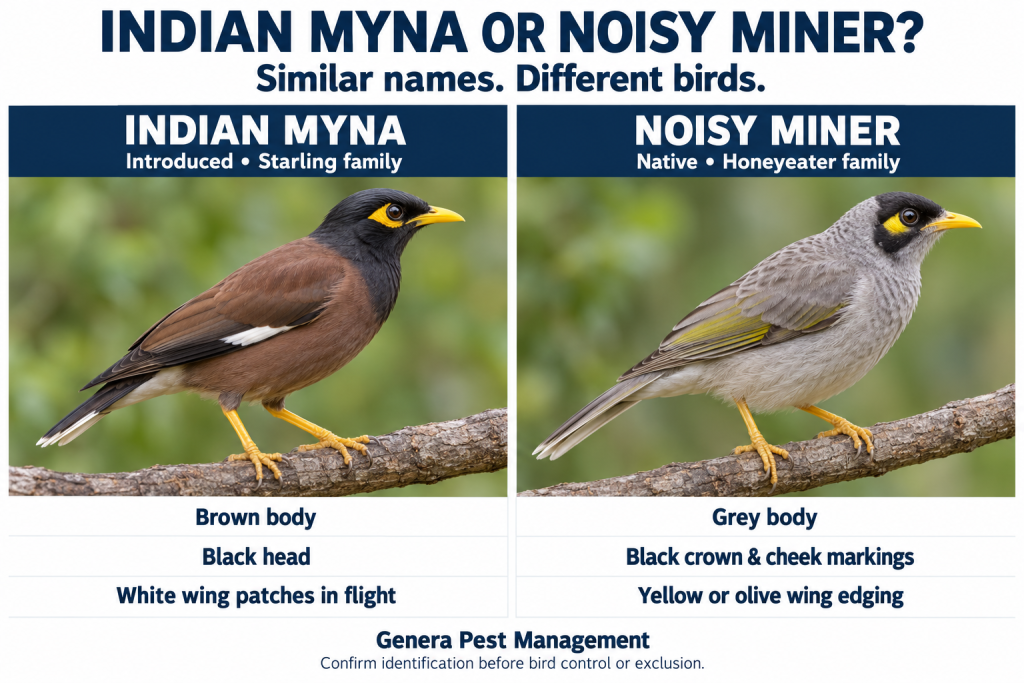
- Body colour: Brown is a useful starting clue for a common myna. A noisy miner’s body is mainly grey.
- Wing markings: Common mynas show prominent white patches in flight. Noisy miners have different plumage, including yellow or olive edging on the wings.
- Protection: The native noisy miner must not be treated as an introduced myna. Confirm identification before management that could affect either species.
| Feature | Indian or common myna | Noisy miner |
|---|---|---|
| Origin | Introduced | Native |
| Main body colour | Brown | Grey |
| Head | Black | Black crown and cheek markings |
| Bill | Yellow | Yellow |
| Bird family | Starling family | Honeyeater family |
BirdLife Australia explains these differences in its myna and miner comparison. Aggressive behaviour alone does not distinguish them. birdlife.org.au
Where do Indian mynas nest around buildings?
Indian mynas use cavities and sheltered locations, including spaces in walls, ceilings and beneath roofs. Nearby tree hollows and palms can also support nesting.
- Roofline access: Repeated entry beneath eaves or behind fascia boards warrants investigation. Note the opening without attempting to block it.
- Concealed cavities: Visible material may extend beyond the accessible edge. Ask how the full nesting location can be assessed.
- Surrounding habitat: Record activity in nearby trees or structures. The birds seen at one opening may also use other locations.
NSW guidance identifies roofs, tree hollows and palms as Indian myna nesting locations. It also recognises competition with native animals for nesting spaces. NSW Government
Are the birds nesting or gathering to roost?
Nesting involves breeding activity, while roosting involves resting or sleeping. Identifying which is occurring helps determine the response.
- Possible nesting: Carrying material or repeatedly delivering food to an opening deserves closer assessment. Eggs or dependent young may be concealed.
- Roosting activity: Groups gathering near dusk may be using a communal resting location. Observe where they settle rather than assuming every gathering contains nests.
- Brief feeding visits: Birds searching the ground and leaving may be exploiting food without occupying the building. Address that source before assuming extensive proofing is necessary.
NSW species guidance describes late-afternoon gatherings and communal roosting behaviour. An inspection should distinguish that activity from occupation of a particular nest cavity. Department of Primary Industries
What food sources encourage mynas to return?
Common mynas are adaptable scavengers that use available food around homes and businesses. Removing predictable feeding opportunities is an important part of prevention.
- Pet food: Avoid leaving bowls accessible outdoors throughout the day. Feed pets indoors where practical.
- Food scraps: Clear outdoor eating areas and collect spilled food beneath furniture. Include areas behind bins and service doors.
- Waste storage: Keep rubbish contained and arrange prompt cleanup of spills. Shared properties need consistent practices across residents or tenants.
Campbelltown City Council recommends reducing exposed pet food and scraps as part of myna prevention. These changes support management without directly handling birds. Campbelltown City Council
How should building access be investigated?
Assess the openings birds actually use and check occupancy before repairs or barriers are installed. A damaged roof section is not automatically the confirmed entry route.
- Observe repeated movements: Identify the precise opening where birds disappear. Photographs can help distinguish similar sections of roofline.
- Check adjoining areas: More than one gap may provide access. Closing one visible opening can leave another route available.
- Coordinate repairs: Explain planned roofing or maintenance work during assessment. The bird specialist and relevant tradesperson may need to agree on timing.
Do not seal an opening while adults are away. Dependent young or other animals may remain inside.
Which management options are appropriate?
The appropriate approach depends on confirmed species, behaviour, occupancy and the building. A useful recommendation should explain why each measure is included.
- Prevention: Reduce feeding opportunities and address maintenance faults. These actions support the response but may not resolve established nesting alone.
- Exclusion: Suitable barriers or repairs can prevent access to assessed spaces. The design must account for bird size and building functions.
- Specialist management: Some established problems require additional consideration. Ask what the proposed program involves and how welfare will be addressed.
For suitable building protection, explore Genera’s bird proofing services. Confirm which locations the proposal protects and what remains outside its coverage.
Do scarers, spikes and netting work for mynas?
Product suitability varies, so equipment should follow assessment rather than the bird’s name alone. A device sold for pigeons may not address myna access or nesting.
- Scarers: Visual and sound devices can lose effectiveness as birds become accustomed to them. Avoid relying on a brief improvement as proof of lasting control. www.dpi.nsw.gov.au
- Ledge products: Ask whether the proposed design suits the bird and activity. Protecting a resting surface does not close a nearby cavity.
- Netting: Mesh must suit the target species, with appropriate edges and maintenance access. Continued checks are necessary to identify damage or wildlife hazards. www.dpird.nsw.gov.au
Request an explanation of limitations. No product should be presented as a universal solution for every myna problem.
Should property owners trap Indian mynas?
Trapping should only be considered with a clear understanding of the required competence, monitoring and treatment of captured birds. Buying a trap is not a complete management plan.
- Ask about local support: Council programs vary in eligibility and availability. Check current arrangements directly with your council.
- Understand the endpoint: Do not assume captured birds will be relocated. Campbelltown’s published program includes training in humane euthanasia and makes participants responsible for disposal.
- Protect other wildlife: Any proposal must address unintended captures and animal welfare. Seek professional advice before starting.
Campbelltown’s program is restricted to its local government area. It should not be treated as a Sydney-wide service or permission for unrestricted trapping. Campbelltown City Council
How can you prevent repeat Indian myna nesting?
Combine appropriate exclusion with consistent housekeeping and checks after building work. Nest clearance alone leaves an accessible space available for reuse.
- Confirm completion: Ask for photographs of protected openings and any remaining defects. Keep the installation and maintenance details.
- Review changes: Roof repairs, scaffolding or servicing can disturb barriers. Tell contractors about existing protection.
- Monitor activity: Record renewed entry, nesting material or fouling. Report changes before another concealed nest becomes established.
Where a nest is already present, discuss Genera’s bird nest removal service before arranging closure.
Frequently asked questions about Indian mynas
These answers address common concerns before arranging assessment.
Are Indian mynas native to Australia?
No, the common or Indian myna is introduced. It is different from the native noisy miner.
- Confirm the brown body and other markings. Do not rely on the common name alone.
Can Indian mynas nest inside a roof?
Yes, they can use building cavities and sheltered roof locations. Repeated entry warrants assessment.
- Photograph the location safely. Leave openings unchanged until occupancy is checked.
Will removing pet food solve the problem?
It can reduce an attractant but may not resolve established nesting. Shelter can remain valuable after food is removed.
- Combine housekeeping with access assessment. Monitor whether activity changes.
Can I remove a nest containing eggs?
Arrange assessment before disturbing it. Species confirmation, welfare and applicable requirements still matter.
- Explain any eggs or young observed. Avoid moving the nest yourself.
Can all mynas be permanently removed from my neighbourhood?
A property-level program should focus on defined impacts rather than promise neighbourhood eradication. Nearby populations may continue visiting.
- Agree on protected areas and measurable results. Maintain prevention measures.
Get a clear plan for your myna problem
Start by confirming the birds and investigating why they use your property. Genera Pest Management can help you discuss the activity and appropriate next steps.
- Share observations: Provide safely taken photographs and details of feeding or nesting activity.
- Review the scope: Confirm prevention, exclusion and follow-up arrangements.
Call Genera Pest Management on 1300 149 549 or book a discovery call to discuss Indian myna control in Sydney.