
Humane bird control in Sydney combines effective property protection with measures that minimise avoidable animal suffering. It starts with identifying the birds, understanding their behaviour and addressing the conditions attracting them. Where exclusion is appropriate, the work must avoid trapping adults, separating dependent young or creating hazards for other wildlife.
You may want pigeons off your balcony or birds out of a warehouse without causing unnecessary harm. That is a reasonable expectation. The challenge is choosing a plan that works for the property and accounts for what happens to the animals.
Responsible management considers the whole process, including what happens after installation.
What does humane bird management mean?
Humane management considers the welfare consequences of a method, how it is implemented and whether it addresses an actual problem. A reassuring product label is not enough.
- Define the impact: Establish whether birds are contaminating a used space, entering a building or causing another documented concern. Occasional bird presence alone does not establish the need for control.
- Choose proportionate measures: Ask how prevention and suitable exclusion have been considered. The recommendation should explain why the proposed approach fits the circumstances.
- Review the result: Protection needs checking after work. Continuing problems or wildlife hazards require prompt reassessment.
NSW best-practice guidance focuses on reducing actual pest impacts using effective, humane and targeted methods. It supports sustained management rather than repeated crisis responses. Department of Primary Industries
Why must the bird species be identified first?
Species identification affects legal requirements, equipment selection and the appropriate response. Birds using the same building may require different management.
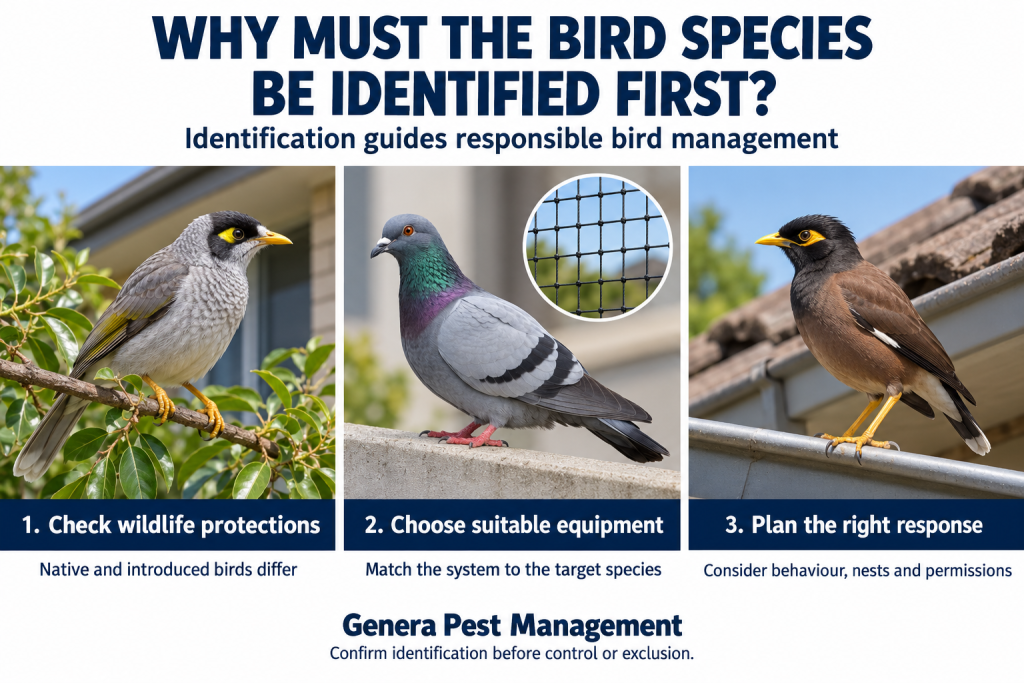
- Confirm identification: Ask which features support the conclusion. Photographs taken without approaching birds can help when activity is intermittent.
- Distinguish native wildlife: Native birds are generally protected in NSW, with limited exceptions. A bird creating inconvenience does not automatically become an unprotected pest.
- Check permissions: Management involving protected species may require authorisation. Clarify relevant requirements before work proceeds. Environment and Heritage
Uncertainty should lead to further assessment. It should not be resolved by assuming all birds around a roof or balcony are feral pigeons.
How does prevention support animal welfare?
Prevention can reduce recurring conflict by making specific building areas less attractive or accessible before birds become established. This can reduce the need for repeated intervention.
- Manage food: Clear scraps, contain waste and avoid leaving pet food exposed. Consistency matters where several residents or businesses share the property.
- Maintain buildings: Report damaged covers and potential entry points. Arrange occupancy checks before closing spaces birds may already use.
- Plan new work: Consider bird access when installing signs, canopies or equipment. Prevention is easier to discuss before concealed nesting spaces become occupied.
City of Ryde recommends measures including covered rubbish storage, indoor pet feeding and repair of building openings. These actions address the conditions supporting bird activity. www.ryde.nsw.gov.au
What habitat changes are appropriate around buildings?
Focus on the specific resources sustaining the problem while protecting valuable native habitat. Responsible management does not require making the whole property unsuitable for wildlife.
- Reduce unintended shelter: Once nesting concerns are assessed, reorganise stored items that conceal building access. Keep inspection routes available.
- Address maintenance faults: Review leaking fixtures, spilled feed and neglected waste areas. Explain which changes are practical for occupants to maintain.
- Treat vegetation carefully: Do not remove trees or nesting habitat simply because birds are nearby. Check relevant protections and seek advice before altering habitat.
The objective is a workable boundary between building use and wildlife activity. Changes should be justified by observed conditions rather than broad assumptions.
When is bird exclusion an appropriate option?
Bird exclusion is appropriate where a defined space can be protected without trapping animals or compromising building functions. The design should suit the species and location.
- Enclosing a space: Netting may suit certain balconies, canopies or recesses. Ask whether the full boundary can be protected.
- Closing an opening: Suitable guards or repairs may prevent building entry. Ventilation, drainage and maintenance requirements must remain functional.
- Protecting a surface: Ledge deterrents may address particular landing areas. They do not necessarily exclude birds from adjoining spaces.
Explore Genera’s bird proofing services when discussing options. Ask what each proposed component protects and what remains accessible.
Why are nest checks essential before exclusion?
Nest checks help prevent adults being sealed inside or dependent young being separated from their parents. A brief absence of birds does not confirm vacancy.
- Inspect concealed locations: Sheltered recesses and cavities may contain material or young out of sight. Ask how inaccessible areas will be assessed.
- Establish breeding activity: Report birds carrying nesting material or food. These observations can affect timing.
- Agree on the next step: Where immediate exclusion is unsuitable, request a monitoring and reassessment plan. Do not choose a closure date without supporting checks.
For nesting concerns, discuss Genera’s bird nest removal service. Assessment should precede decisions about removal or proofing.
Can non-lethal bird management still cause harm?
Yes, a method intended to avoid killing birds can still cause injury or distress if poorly selected or maintained. Welfare depends on the outcome and implementation, not just the category.
- Poorly fitted netting: Wildlife may become entangled or enter through gaps without escaping. Material, design and maintenance all matter.
- Inappropriate placement: Equipment must suit the location and species. Avoid assuming a product is harmless in every application.
- Unmonitored changes: Damage or later building work can create hazards. The management plan needs a response when conditions change.
NSW guidance specifically warns that the humaneness of netting depends on its type, application, maintenance and checking. dpird.nsw.gov.au
Is trapping and relocation automatically humane?
No, capture and relocation should not be assumed to be a simple, harmless solution. Ask what the proposed activity involves and what happens to captured birds.
- Clarify the method: “Removal” can describe different processes. Request a clear explanation before approving work.
- Ask about welfare: Handling, confinement, monitoring and the fate of dependent young require consideration. Specialist methods need competent operators.
- Understand the endpoint: Do not assume captured birds will be released elsewhere. NSW guidance discusses trapping programs that involve humane killing rather than relocation. dpi.nsw.gov.au
If your requirement is exclusively non-lethal management, state it during the initial discussion. Ask the provider to identify whether that objective is achievable at your site.
What monitoring should follow the work?
Monitoring should check both property protection and animal welfare. An installation is not complete in practice if nobody can identify emerging problems.
- Observe safely: Look for trapped animals, loose material or renewed entry from accessible positions. Do not climb or reach outside to inspect.
- Arrange maintenance: Agree who checks fixings, access openings and system condition. Keep records of repairs and later alterations.
- Respond promptly: Establish a contact for wildlife concerns. Trapped or entangled animals need appropriate assistance without delay.
NSW netting guidance recommends regular checking, preferably at least twice daily. Discuss how routine observation and professional condition inspections will be organised. www.dpird.nsw.gov.au
How do you select a responsible provider?
Choose a provider that explains the assessment, method, welfare precautions and follow-up clearly. Ask for evidence relevant to the proposed work rather than relying on general assurances.
- Assessment quality: Expect identification of the birds and the problem locations. Ask how the recommendation follows those findings.
- Transparent scope: Confirm occupancy checks, relevant permissions, installation boundaries and exclusions. Clarify any work requiring another trade.
- Aftercare: Request inspection requirements, maintenance responsibilities and the process for reporting wildlife hazards. Understand warranty conditions before accepting.
NSW animal-welfare legislation aims to prevent cruelty and promote humane treatment. A provider’s approach should reflect those responsibilities throughout the work. Department of Primary Industries
Frequently asked questions about humane bird control
These answers clarify common concerns before arranging an assessment.
Is humane bird control always non-lethal?
The terms are not interchangeable. Humane practice considers suffering, while non-lethal describes an intended outcome.
- State your requirements clearly. Ask exactly what the proposed method involves.
Is humane pigeon control possible without trapping?
Some properties can be managed through prevention and suitable exclusion. Feasibility depends on activity, occupancy and the building.
- Request an assessment of those options. Avoid expecting the same solution at every site.
Is bird netting safe for wildlife?
Correctly selected, installed and monitored netting can provide humane exclusion. Poor conditions can create entanglement or entrapment hazards.
- Confirm the inspection arrangements. Report damage or trapped animals promptly.
Can I block a hole after the birds fly out?
Adults leaving does not prove the space is empty. Eggs or dependent young may remain concealed.
- Arrange occupancy checks first. Do not improvise exclusion around an unchecked nest.
Does responsible management remove every bird nearby?
The objective should be reducing the documented property problem. Birds may remain elsewhere in the surrounding area.
- Agree on the protected locations. Measure entry, fouling or other relevant activity.
Choose a plan that protects your property responsibly
Start with assessment, clear expectations and an explanation of the welfare precautions. Genera Pest Management can help you discuss the bird activity and suitable management options.
- Explain your priorities: Describe the property problem and any requirement for non-lethal methods.
- Review the proposal: Confirm species checks, exclusion arrangements and monitoring before work begins.
Call Genera Pest Management on 1300 149 549 or book a discovery call to discuss humane bird control in Sydney.