
Yes, bird spikes work when the product suits the target birds, covers the usable landing surface and is installed securely. They are commonly used to discourage pigeons and larger birds from settling on ledges. They do not enclose a space or prevent access through nearby openings, and conventional pigeon spikes may be unsuitable for smaller birds.
If birds still gather around installed spikes, the problem deserves investigation. The species, coverage or location may differ from what the product was designed to address.
For Sydney property owners, the useful question is whether spikes suit the activity on that particular surface.
How do bird spikes discourage landing?
Bird spikes occupy the space birds would otherwise use to gain stable footing. Their intended function is to discourage landing rather than injure birds.
- Surface protection: The installation protects the area covered by the selected arrangement. A bird landing on an untreated section nearby does not necessarily establish that the covered section has failed.
- Physical interference: The upright elements make the surface less usable for the target birds. Product dimensions and spacing influence that effect.
- Defined boundaries: Spikes do not stop birds flying above the building or entering other spaces. The proposal should identify exactly what protection is intended.
Manufacturer guidance describes spikes as anti-landing devices rather than complete barriers. That distinction helps set realistic expectations.
Which ledges and surfaces may suit spikes?
Spikes may suit accessible landing surfaces where the product can be positioned and attached appropriately. The inspection should consider the surface’s width, shape and condition.
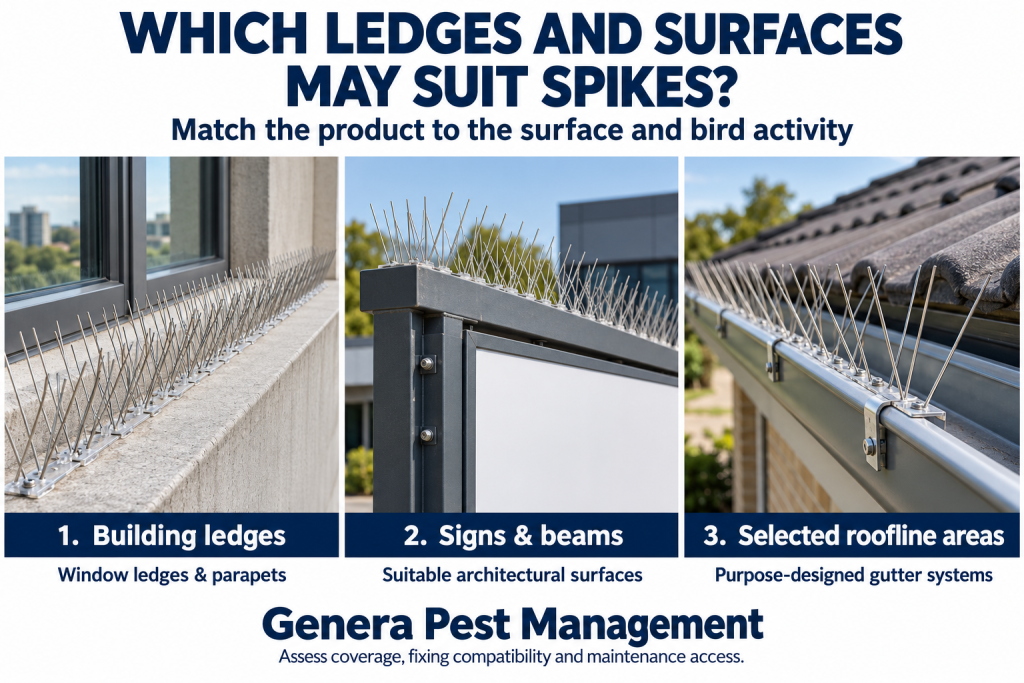
- Building ledges: Window ledges, parapets and similar features may be candidates. Ask whether the full usable depth can be protected.
- Signs and beams: Some products can accommodate particular architectural features. Confirm that fixings and servicing access suit the structure.
- Selected roofline locations: Certain systems are designed for roof edges or gutters. Do not assume a standard ledge product is appropriate for every roof detail.
Manufacturers offer different widths and attachment arrangements. The product should follow the location, rather than forcing one strip design onto every surface.
Which birds are pigeon spikes designed for?
Conventional pigeon spikes generally target pigeon-sized or larger birds, with suitability dependent on the particular product. Smaller species require separate consideration.
- Confirm identification: Ask which birds are using the surface. Photographs can assist when activity is absent during inspection.
- Check small-bird activity: Smaller birds may perch between conventional spike elements. Some can also use the structure to support nesting material.
- Avoid universal claims: A product advertised for pigeons should not automatically be treated as protection against every species. Request its stated applications and limitations.
Bird B Gone specifically cautions that conventional spikes intended for larger birds are unsuitable as a first response to smaller species.
Why does bird behaviour affect the result?
A brief landing and an established nesting location present different management challenges. The proposed system must account for how strongly birds use the site.
- Occasional resting: A bird using an exposed ledge briefly may respond differently from one occupying a sheltered recess. Explain the pattern you observe.
- Repeated occupation: Record whether birds remain overnight or return throughout the day. This helps establish the significance of the location.
- Nesting: Eggs, dependent young or nest-building activity require assessment before installation. Product guidance varies, so an occupied nesting site should not receive a generic spike recommendation.
Some manufacturers recommend exclusion systems instead of spikes for active nesting areas. Confirm the current guidance for the proposed product and the site findings.
Why is complete coverage important?
Birds may continue using a ledge if sufficient landing space remains beside, behind or between installed sections. Buying the right material does not compensate for an incomplete layout.
- Ledge depth: A single strip may leave usable space on a wide surface. Ask how the arrangement addresses the whole landing area.
- Ends and corners: Interruptions can leave opportunities for birds. Inspect these details when reviewing installation photographs.
- Adjoining features: Birds may transfer to a nearby bracket, sign or recess. Include surrounding surfaces in the assessment.
Manufacturer instructions emphasise correct placement and secure attachment. Spacing requirements differ between products, so there is no universal gap measurement suitable for every installation.
What matters during installation?
Installation must provide secure attachment without creating avoidable damage or interfering with the building. The method should suit both the product and the supporting material.
- Surface condition: Ask whether loose paint, corrosion or other defects need attention first. Attaching strips to a deteriorating finish may leave the underlying problem unresolved.
- Fixing compatibility: Adhesives, mechanical fixings and clamps have different applications. Request confirmation that the proposed method suits the surface.
- Building functions: Discuss drainage, waterproofing and maintenance access. Check necessary owner or strata permissions before work affecting the building proceeds.
Avoid specifying a fixing method solely because it appears easier. The installer should explain why it is appropriate.
Should the area be cleaned before fitting spikes?
The mounting area generally needs suitable preparation, but cleaning must account for contamination and access conditions. Do not simply brush dried droppings away to expose a fixing surface.
- Assess accumulated material: Extensive fouling or concealed debris may require specialist cleaning. Confirm whether preparation is included in the installation quote.
- Manage dust: NSW Health advises dampening bird droppings before cleaning and using appropriate protective equipment. Avoid dry disturbance that spreads material into the air. www.health.nsw.gov.au
- Check nesting first: Do not remove occupied nests as routine preparation. Species and occupancy checks come before deciding when work can proceed.
Cleaning and installation should be coordinated. Ask who handles each task and what remains outside the quoted scope.
Do bird spikes need maintenance?
Spikes need condition checks and attention to debris or damage that compromises their function. “Low maintenance” does not mean the installation can be ignored indefinitely.
- Attachment: Look for lifting bases, loose sections or displaced components from a safe position. Arrange professional attention where access is difficult.
- Debris: Leaves and nesting material can accumulate in some situations. Ask how cleaning will be performed without damaging the system.
- Later work: Painting, roof repairs or sign servicing can disturb spikes. Tell contractors where protection is installed and arrange reinstatement checks.
Manufacturer specifications recognise that retained debris may need removal. Agree on inspection and maintenance arrangements at handover.
When should another system be considered?
Consider alternatives when the problem involves entry into a space, unsuitable species or conditions the proposed spikes cannot address. Adding more strips is not always the appropriate response.
- Area exclusion: Netting may suit a recess containing several resting surfaces. Its feasibility depends on boundaries, access and wildlife considerations.
- Discrete openings: Roof gaps or access beneath solar panels may require appropriate guards or repairs. Protecting an adjacent ledge leaves the opening available.
- Appearance requirements: Some exposed ledges may suit a designed wire system. Suitability still depends on species and activity.
Genera’s bird proofing services provide a starting point for comparing options. A recommendation should explain why the selected method fits the observed problem.
What should you ask before approving spikes?
Request a proposal that defines the target birds, protected surfaces and expected result. This makes the recommendation easier to assess.
- Why this product? Ask about species suitability and behavioural limitations. Confirm the proposed coverage.
- What is included? Check cleaning, access equipment and repairs. Clarify any separate charges.
- How is performance reviewed? Understand warranty conditions and maintenance responsibilities. Agree how continuing activity will be investigated.
For context, Genera’s Randwick hotel case study explains that spikes on particular surfaces may not resolve an established building-wide pigeon problem. generapestmanagement.com
Frequently asked questions about bird spikes
These answers address common expectations before choosing ledge bird deterrents.
Do bird spikes stop pigeons permanently?
They can discourage landing on protected surfaces, but cannot guarantee that pigeons never return nearby. Coverage and maintenance affect performance.
- Define the area being protected. Monitor whether birds continue using it.
Can birds nest on top of spikes?
Nesting material can accumulate, and some smaller birds may use conventional spikes as support. Species and behaviour need reassessment.
- Report nest-building activity. Do not disturb an occupied nest yourself.
Are plastic or stainless steel spikes better?
Compare the particular products rather than choosing by material alone. Design, exposure and attachment also matter.
- Request specifications and warranty conditions. Confirm suitability for the location.
Why are pigeons sitting beside my spikes?
They may have found usable space outside the protected coverage. The surrounding layout deserves inspection.
- Photograph the location safely. Ask whether gaps or adjoining surfaces explain the activity.
Can I install bird spikes myself?
Suitability depends on access, building permissions and the installation requirements. Elevated or contaminated locations warrant professional assessment.
- Avoid reaching over railings or climbing roofs. Confirm occupancy before altering nesting areas.
Find out whether spikes suit your property
Start with an assessment of the birds, behaviour and surfaces involved. Genera Pest Management can help you discuss suitable protection and realistic expectations.
- Describe the activity: Share observations and safely taken photographs.
- Review the recommendation: Confirm coverage, preparation and maintenance before approving work.
Call Genera Pest Management on 1300 149 549 or book a discovery call to discuss bird spikes and other proofing options for your Sydney property.