
Solar panel bird proofing in Sydney involves inspecting the space beneath an array, checking for occupied nests and installing compatible barriers to prevent renewed access. Effective protection must account for the birds, roof profile and solar equipment, including ventilation and future servicing.
If pigeons repeatedly disappear beneath your panels, you may wonder whether they are nesting or simply sheltering. Noise, droppings and visible debris can add to the concern, especially when you cannot inspect the area safely.
The next step is an assessment that explains what is happening and how to address it without damaging the installation.
What are the signs of birds nesting under solar panels?
Repeated entry beneath the same panels, birds carrying nesting material and persistent calls suggest nesting activity. A bird briefly landing on the array does not confirm an occupied nest.
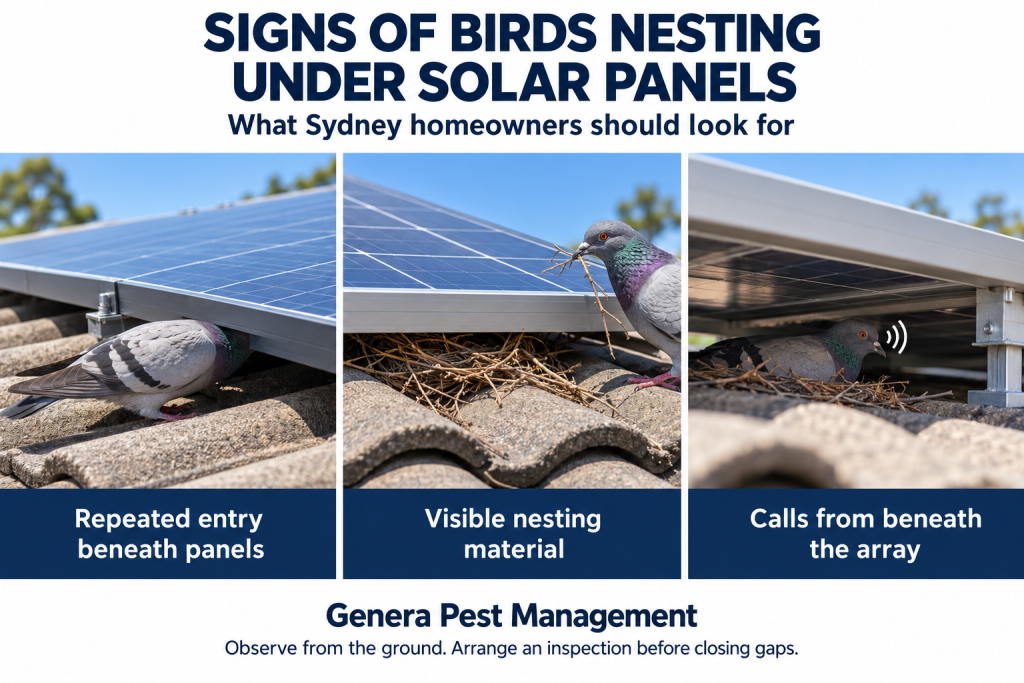
- Regular movements: Observe from ground level whether birds disappear beneath panel edges. Record where they enter and whether they return throughout the day.
- Visible nesting material: Twigs or grass protruding beneath panels can direct the inspection. Debris alone does not establish whether eggs or dependent young are present.
- Droppings and calls: Concentrated droppings nearby or repeated sounds may support your observations. Ask the inspector to confirm the source rather than assuming every roof noise comes from birds.
Photographs taken safely from the ground can help explain the suspected location. There is no need to climb onto the roof before booking an assessment.
Why do pigeons choose the space beneath panels?
The gap beneath a solar array can provide a sheltered place to rest or nest. Removing birds without addressing that access leaves the same space available.
- Protected roof space: The panels provide overhead cover while gaps around their edges allow entry. The inspection should identify which openings birds actually use.
- Limited disturbance: Owners rarely see the underside of an array. Activity may continue unnoticed until calls, debris or droppings become apparent.
- Nearby resources: Accessible food and water elsewhere can support repeat visits. Improving housekeeping helps, but does not close the nesting space beneath the panels.
The practical objective is to prevent access to the protected area. Birds may still visit other parts of the roof.
What should a solar panel bird inspection establish?
The inspection should identify the birds, assess nesting activity and determine how exclusion can be fitted around the existing installation. It should also identify work requiring a solar specialist or roofer.
- Occupancy and species: Ask whether there are adults, eggs or dependent young beneath the array. Native birds are generally protected in NSW, so identification matters before nest management. www.environment.nsw.gov.au
- Access and layout: Check the array perimeter, separate panel groups and changes in roof level. Ask whether concealed areas can be assessed without disturbing equipment.
- Visible concerns: Request photographs of debris or suspected damage. A bird inspection should not be represented as electrical testing of the solar system.
Provide your installation paperwork where available. Panel models and equipment details help the relevant professionals check compatibility.
Which bird proofing options suit solar panels?
A purpose-designed perimeter barrier may prevent birds entering beneath panels, provided it suits the installation. The proposal should explain its coverage and how it accommodates the roof and array.
- Solar panel bird mesh: Mesh can be shaped around an array’s perimeter. Ask how corners, roof contours and changes in height will be addressed.
- Rigid guard systems: Some installations may suit purpose-designed rigid barriers. Compare their mounting requirements and service access with alternative systems.
- Supplementary ledge protection: Other measures may be proposed for nearby resting surfaces. These do not replace protection of an accessible space beneath the panels.
Genera’s existing solar panel bird proofing information describes its use of fitted perimeter mesh. The final system should follow assessment of your property. Mesh Installation & Nest Removal Services
How do you check installation compatibility?
Compatibility must be checked against the particular panels, mounting equipment and manufacturer instructions. A product described as suitable for solar panels is not automatically appropriate for every array.
- Confirm fixing methods: Ask whether clips, fasteners or other attachments are permitted. JinkoSolar’s installation guidance, for example, prohibits unauthorised drilling into module frames. jinkosolar.com
- Preserve equipment functions: Ask the solar professional to check ventilation, drainage and access requirements. The barrier should not obstruct components or place pressure on cables.
- Check warranty conditions: Obtain relevant advice before installation. Avoid relying on a blanket promise that any mesh system will leave every warranty unaffected.
Non-drilling fixings still need assessment. Their suitability depends on how they attach to the particular frame.
When should a solar professional be involved?
Involve a suitably qualified solar professional when electrical assessment, panel movement or changes to the installation may be required. Bird management and electrical work have different scopes.
- Suspected electrical damage: Report visible cable concerns, system faults or other electrical symptoms. Electrical work must be carried out by an appropriately licensed electrician. NSW Government
- Restricted nest access: Ask whether material can be reached without moving panels. If removal or reinstatement is necessary, arrange the appropriate contractor.
- Isolation questions: Do not assume switching off the inverter removes all electrical hazards. SafeWork NSW warns that wiring between panels and the inverter can remain live. SafeWork NSW
Agree who coordinates each contractor. This helps prevent cleaning or proofing proceeding before necessary electrical or roofing work.
How are birds protected during exclusion?
The space must be assessed before barriers are closed so birds are not trapped or separated from dependent young. Adults leaving temporarily does not establish that a nest is empty.
- Assess occupied nests: Request an explanation of how species and breeding stage affect timing. Where exclusion must wait, agree on reassessment.
- Confirm vacancy: Check concealed areas before completing the enclosure. Do not rely solely on a quiet period.
- Review the finished work: Ask how gaps and unintended entry routes will be checked. Suitable inspection and maintenance are essential to humane exclusion. www.dpird.nsw.gov.au
For nest concerns, discuss Genera’s bird nest removal service before arranging installation.
What access and cleaning arrangements are needed?
The contractor should assess roof access and explain how debris will be removed without compromising the roof or solar equipment. Height, roof condition and panel placement affect the work.
- Safe access: Discuss roof pitch, available working space and necessary access equipment. Do not expect every array to be reached safely using the same method.
- Cleaning scope: Confirm whether the quote includes nesting debris, affected roof areas or gutters. Panel cleaning is a separate task unless specifically included.
- Dust control: Dried droppings require appropriate handling. NSW Health advises dampening droppings before cleaning and using suitable protective equipment in its bird hygiene guidance. www.health.nsw.gov.au
Do not reach beneath panels with tools or direct water towards concealed electrical components. Leave access and cleaning methods to the relevant professionals.
What maintenance prevents repeat nesting?
Proofing needs checks for displacement, deterioration and openings created during later work. Agree on maintenance requirements when the system is installed.
- Routine inspections: Ask the installer for a schedule suited to the product and site. Use safe observations between professional visits.
- Checks after servicing: Panel replacement or roof repairs may disturb barriers. Ensure contractors know the proofing must be reinstated and checked.
- Renewed activity: Report birds entering beneath the array, rather than merely landing nearby. Record the location so the provider can investigate.
Keep completion photographs and product details. They provide a useful reference when arranging repairs or future solar servicing.
Frequently asked questions about solar panel pigeon proofing
These answers address common planning questions, but the installation details should follow a property assessment.
Can I install solar panel bird mesh myself?
Professional assessment is the appropriate starting point because the work involves roof access and proximity to electrical equipment. Mesh selection is only one part of the job.
- Have compatibility and occupancy checked first. Avoid moving panels or interfering with wiring yourself.
Will bird proofing affect my solar panel warranty?
That depends on the equipment, attachment method and warranty terms. There is no universal answer covering every installation.
- Ask your solar supplier or manufacturer about the proposed system. Keep the response with your installation records.
Do the panels need to be removed?
Not necessarily, but restricted access or concealed debris may require panel movement. The inspection should establish what is accessible.
- Request separate details for any solar contractor work. Confirm who will remove, reinstate and check affected equipment.
Will mesh stop pigeons landing on top of panels?
Perimeter mesh is intended to prevent access underneath, not eliminate every roof landing. Agree on that distinction before installation.
- Monitor entry beneath the array. Discuss separate resting-site concerns if they continue.
Can proofing be installed before birds start nesting?
Yes, preventive exclusion can be considered before occupation. Compatibility and safe installation still need checking.
- Raise the question with your solar installer during planning. Confirm that the selected protection suits the completed system.
Arrange a plan for your solar array
Start with an assessment that connects bird management, equipment compatibility and maintenance. Genera Pest Management can help you discuss the activity and appropriate proofing options.
- Describe the problem: Share safely taken photographs and the locations birds use.
- Clarify the scope: Confirm nest checks, cleaning, access and any solar contractor involvement.
- Plan follow-up: Keep installation records and agree how renewed activity will be reviewed.
Call Genera Pest Management on 1300 149 549 or book a discovery call to discuss solar panel bird proofing in Sydney.