
Bird netting in Sydney can provide effective exclusion where a building space can be enclosed without compromising its use or maintenance access. Suitability depends on the birds present, the structure, fixing locations and ongoing inspection arrangements. Netting must be designed for the site rather than simply stretched across a visible opening.
If birds repeatedly occupy your balcony, canopy or building recess, cleaning alone can become frustrating. You want protection that addresses access while allowing the property to function normally.
A useful assessment establishes whether netting is appropriate, what area it will protect and how it will be maintained.
When is bird netting an appropriate solution?
Netting is worth considering when the objective is to exclude birds from a defined space. It creates a physical barrier, rather than treating individual landing surfaces.
- Several surfaces need protection: A recessed area may contain beams, pipes and ledges. Enclosing the space can avoid addressing each resting point separately.
- The boundary can be completed: Ask how the installation will meet surrounding walls and structures. Remaining openings can compromise the intended coverage.
- Maintenance is practical: Someone must be able to observe the netting and arrange repairs. Establish those responsibilities before installation.
NSW guidance recognises exclusion netting as potentially effective and humane when correctly applied and maintained. It also notes that netting can be impractical or uneconomic in some situations. dpird.nsw.gov.au
Which building areas can bird netting protect?
Netting can suit enclosed or partly enclosed building areas where birds enter, rest or nest. The layout and normal use determine whether a workable design is possible.
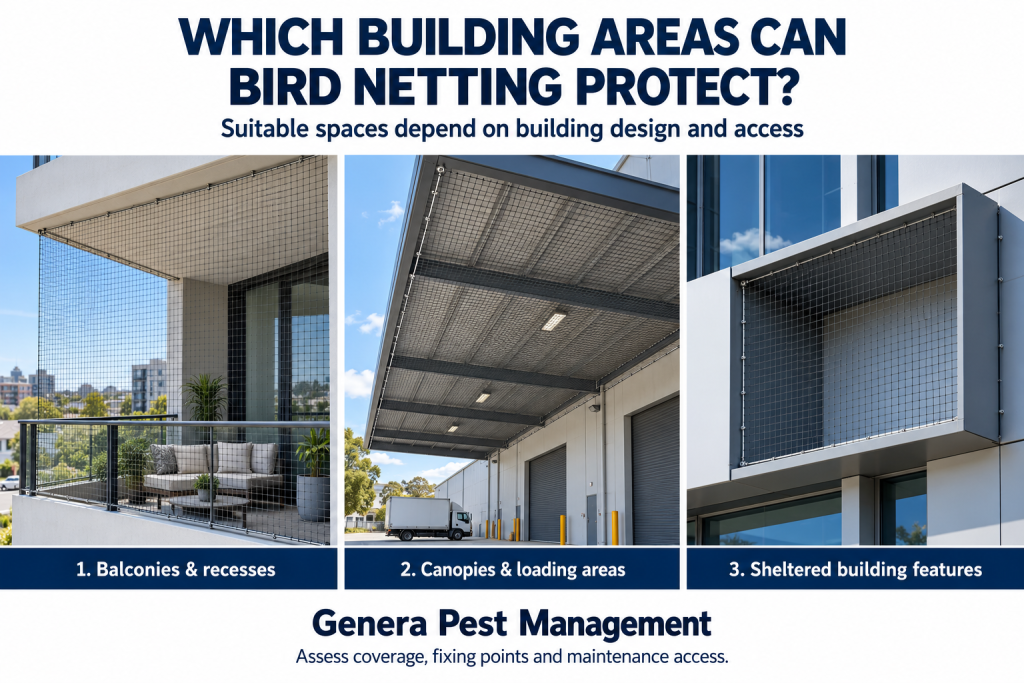
- Balconies and recesses: Balcony bird netting may protect a sheltered apartment space. Doors, appearance and resident access still need consideration.
- Canopies and loading areas: Commercial bird netting may exclude birds from overhead structures. Vehicle movements and maintenance operations must fit the proposed design.
- Building features: Courtyards, signs and other structural spaces may be suitable. Ask whether the whole problem area can be protected.
Manufacturer guidance identifies balconies, loading docks, façades and open beam structures among possible applications. These are examples, rather than confirmation that every such location suits netting. Bird Barrier
How does the bird species affect netting design?
The mesh and installation must suit the target birds, including any smaller species using the same area. A barrier selected for pigeons may not exclude every bird.
- Confirm identification: Ask which birds the system is intended to exclude. Where activity is intermittent, observations or photographs can assist assessment.
- Specify the mesh: Manufacturers supply different mesh sizes for different species. Request the proposed product specification rather than accepting an unspecified “bird net.”
- Assess mixed activity: Tell the inspector if smaller birds also enter. The design should account for the actual species involved.
For example, Bird Barrier specifies different meshes for small birds, starlings and pigeons. Those product recommendations illustrate why mesh selection requires identification, not guesswork. Bird Barrier
Why do fixing points matter?
The support system must attach appropriately to the building and hold the netting in its intended position. The condition of the supporting surface matters alongside the net itself.
- Check the material: Concrete, masonry, steel and timber need appropriate fixing arrangements. Ask how the installer will assess the proposed attachment locations.
- Identify defects: Loose finishes or damaged components may require repair first. Confirm whether another contractor must assess the structure.
- Protect building functions: Discuss waterproofing, drainage and nearby services before attachments are installed. Obtain relevant permissions where building fabric will be altered.
Manufacturer specifications describe perimeter support systems with hardware selected for the mounting surface. They also require preparation and correction of relevant installation defects. Bird Barrier
Why should access panels be planned before installation?
Access openings allow equipment and enclosed areas to be serviced without cutting or dismantling the netting unnecessarily. Their position should reflect actual maintenance tasks.
- Identify servicing locations: Show the installer lights, valves and equipment behind the proposed barrier. Explain how contractors currently reach them.
- Confirm usable openings: Ask whether access points are large enough and appropriately positioned. A small opening elsewhere may not meet the maintenance requirement.
- Agree on closure: Explain who must secure the opening after work. An access point left open becomes an entry route.
Purpose-designed zippers or clips are available in some systems for maintenance access. Confirm what the selected product offers and how it will be used. Bird Barrier
What should installation quality look like?
A completed installation should match the agreed coverage and product requirements, with secure edges and functioning access points. Request an explanation of how the work will be checked.
- Coverage: Ask for photographs showing corners, junctions and penetrations. These help establish whether the protected boundary has been completed.
- Fit: Netting should follow the specified installation requirements without unintended loose sections. Ask the installer to explain any unusual shape or clearance.
- Handover: Obtain product details, inspection instructions and warranty terms. Record locations that need particular attention.
Manufacturer guidance emphasises correct mesh, secure fitting and correction of installation problems. A material warranty should not be mistaken for proof that every aspect of installation is covered. Bird Barrier
How should wildlife be protected during exclusion?
The area must be assessed before closure so birds and other animals are not trapped inside. Nest occupancy can affect the appropriate installation timing.
- Check concealed spaces: Inspect potential nesting locations within the enclosure. Adults leaving temporarily does not confirm that dependent young are absent.
- Confirm the approach: Ask how occupied nests and relevant wildlife permissions will be addressed. Do not assume installation can proceed immediately.
- Respond promptly: Arrange assistance if wildlife becomes trapped or entangled. Avoid reaching from a height or attempting an unsafe rescue.
NSW guidance identifies both entanglement and animals entering beneath netting without being able to escape as welfare concerns. Appropriate design and continued checking are essential. dpird.nsw.gov.au
How often should netting be inspected?
Netting needs routine observation as well as planned checks of its condition and fixings. These are different tasks and may involve different people.
- Routine wildlife checks: NSW guidance recommends regular checking, preferably at least twice daily. Agree how this can be achieved safely for the installation.
- Condition inspections: Ask the installer for a schedule covering mesh, supports and access closures. Confirm which checks require professional access.
- Additional checks: Report changes after storms, building repairs or equipment servicing. Do not wait for a scheduled visit where visible damage appears. dpird.nsw.gov.au
Keep dated inspection records and a contact for urgent concerns. Routine observation does not mean residents should climb onto roofs.
What happens if bird netting is damaged?
Damage should be assessed promptly because openings or displaced material can undermine exclusion. The repair must restore the system’s intended coverage.
- Report clearly: Photograph the location from a safe position. Explain whether birds are entering or wildlife is caught.
- Avoid improvised alterations: Do not cut access holes or add unrelated netting without advice. Changes can affect surrounding sections.
- Confirm repair scope: Ask whether the mesh, support or building attachment needs attention. Record the completed repair.
Tell other contractors about installed netting before work begins. Agree who reinstates and checks any section they disturb.
What should you confirm before accepting a quote?
A useful quote defines the protected area, system and ongoing obligations. Compare equivalent scopes rather than material price alone.
- Installation: Check mesh specification, fixing arrangements and access openings. Confirm any required building or strata approvals.
- Preparation: Ask whether nest assessment, cleaning and repairs are included. Clarify responsibilities for separate trades.
- Aftercare: Review inspection requirements, warranties and repair charges. Establish who responds to wildlife concerns.
Genera’s bird proofing services provide a starting point for discussing suitable protection. Ask how the proposal addresses your building’s specific activity.
Frequently asked questions about bird netting
These answers cover common questions before arranging a bird exclusion assessment.
Does bird netting stop all birds entering?
Only when its specification and coverage suit the birds involved. Mesh size, boundary gaps and maintenance affect performance.
- Confirm the target species. Ask how adjoining openings will be addressed.
Is balcony bird netting suitable for apartments?
It may be suitable where the balcony can be enclosed appropriately. Appearance, access and approvals need checking.
- Discuss the design with your strata manager. Tenants should also involve their landlord.
Can tradespeople access equipment behind netting?
Yes, where suitable access openings are included. Their position and size must match servicing needs.
- Identify equipment before installation. Confirm how openings are secured afterwards.
Can I use garden netting on a building?
Do not assume garden netting is appropriate for building exclusion. Material, support and wildlife risks require assessment.
- Request a purpose-designed proposal. Avoid loose, improvised installations.
How long will bird netting last?
Lifespan depends on the product, exposure, installation and maintenance. There is no universal replacement interval.
- Obtain the product warranty and inspection instructions. Address defects rather than relying on age alone.
Find out whether netting suits your property
Start with an assessment of the birds, building and area needing protection. Genera Pest Management can help you discuss whether netting or another method is appropriate.
- Share the problem: Describe where birds enter and provide safely taken photographs.
- Request a clear plan: Confirm coverage, servicing access and maintenance responsibilities.
Call Genera Pest Management on 1300 149 549 or book a discovery call to discuss bird netting for your Sydney building.