
Bird nest removal in Sydney should begin with identifying the species, checking whether the nest contains eggs or dependent chicks and establishing which permissions apply. Removal should proceed only when appropriate, followed by suitable repairs or bird exclusion to reduce repeat nesting.
Finding a nest beneath your eaves or inside a roof opening can leave you unsure what to do. You want to protect your property without harming birds or paying for work that leaves the original access point open.
The first step is assessment. It establishes whether removal is suitable now, whether monitoring is needed and how the nesting location can be protected afterwards.
Why is a bird nest assessment necessary?
A bird nest assessment establishes what is present and whether the proposed work can proceed appropriately. A nest’s location or untidy appearance does not reveal its species, occupancy or legal status.
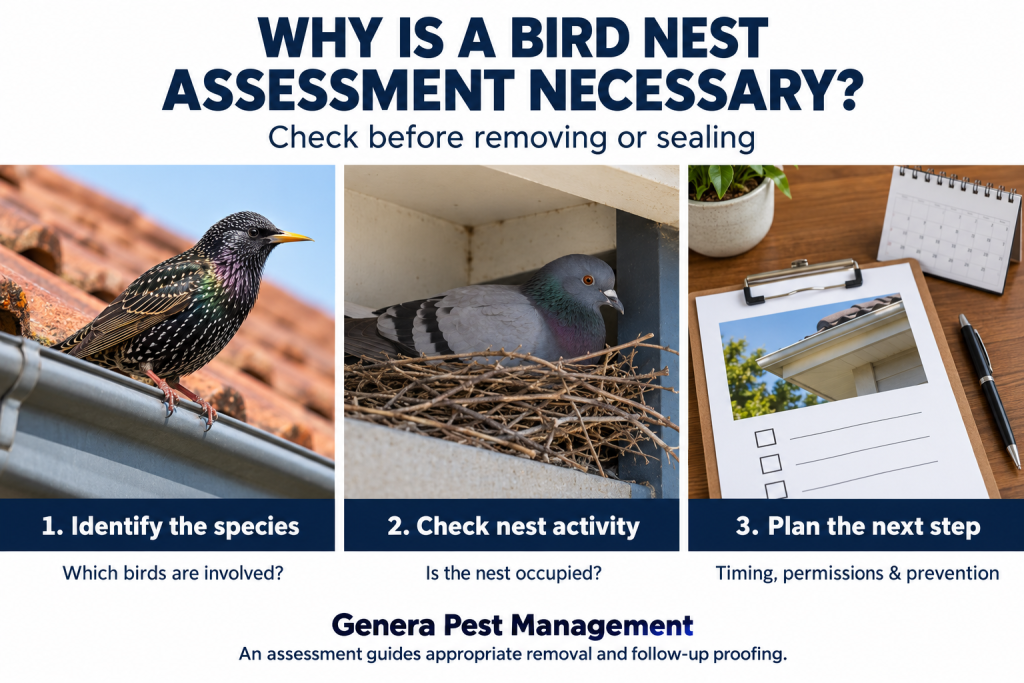
- Identify the actual problem: Explain whether you are concerned about access, fouling, noise or planned repairs. Different concerns may require different responses.
- Check concealed spaces: The visible nest material may extend behind fascia boards or into a cavity. Ask how inaccessible areas will be assessed.
- Define the next step: Request a recommendation covering removal, monitoring or referral. The findings should explain why that approach suits the situation.
An assessment helps prevent avoidable mistakes, such as closing an opening while birds remain inside.
Why does identifying the species come first?
Species identification determines which wildlife protections and management options need consideration. Native birds are generally protected in NSW, with limited exceptions, so nesting on a building does not automatically make a bird an introduced pest. Licences and permits …
- Observe visiting adults: Photographs taken without disturbing the birds can assist identification. Include their size, markings and the location they enter.
- Avoid assumptions: A bird nest in eaves does not establish which species built it. Similar building spaces can be used by different birds.
- Resolve uncertainty: If identification remains unclear, further observation or specialist advice may be necessary. Do not proceed on the basis that a bird simply looks familiar.
The provider should explain the identification and any uncertainty. This gives you a clear basis for understanding the proposed work.
How do you know whether a nest is active?
An active nest may show breeding behaviour, adult attendance, eggs or dependent young. A quiet nest or a short absence of adults is not reliable evidence that it has been abandoned.
- Repeated visits: Birds entering the same opening or carrying material can indicate ongoing use. Note the pattern from a safe distance.
- Feeding behaviour: Adults repeatedly arriving with food may indicate dependent chicks. Report this when arranging the inspection.
- Nest contents: Concealed eggs or young may require a closer professional assessment. Avoid pulling material aside to check them yourself.
Where immediate inspection cannot establish occupancy, ask what further checks are needed. Uncertainty should be resolved before removal or exclusion.
What happens if there are eggs or chicks?
Eggs or dependent chicks change the assessment and can affect whether work should be delayed or require specialist involvement. The response depends on the species, circumstances and applicable requirements.
- Avoid disturbing the nest: Do not move it to another ledge or nearby tree. A seemingly convenient relocation can disrupt parental care.
- Discuss a monitoring plan: Where leaving the nest temporarily is appropriate, agree when it will be reassessed. Ask how completion of breeding will be confirmed.
- Seek help for distressed wildlife: Injured birds or displaced young need appropriate advice. Wildlife rescue assistance is different from routine nest clearance.
If birds have already fallen or been displaced, keep people and pets away while seeking guidance. Do not assume every young bird outside a nest needs removal from its parents.
Do you need permission to remove a bird nest in NSW?
Permission requirements depend on the species, proposed action and site circumstances. Property ownership alone does not authorise activities that would unlawfully harm protected wildlife.
- Protected native wildlife: Discuss proposed action with the relevant authority where necessary. NSW provides licensing pathways for certain situations involving safety threats, property damage or economic hardship.
- Licence conditions: Where a licence applies, the work must comply with its conditions. Ask who holds the authorisation and which activities it covers.
- Building permission: Separately check landlord, strata or other property approvals where access or alterations are involved. Building approval does not replace wildlife authorisation. Environment and Heritage
Ask the provider to clarify the basis for proceeding. A general statement that “all nests can be removed” is insufficient.
When is nest removal appropriate?
Removal may be appropriate after occupancy, species and permission checks establish that the work can proceed. The decision should address a defined property concern rather than treat every nest as requiring removal.
- Confirmed vacant material: An unused nest affecting a building area may be considered for removal after relevant checks. Vacancy alone should not be treated as universal permission.
- Planned repairs: Explain the repair requirement and deadline during assessment. The bird specialist and tradesperson may need to coordinate timing.
- Immediate concerns: Report a suspected blocked flue, damaged electrical equipment or another urgent hazard promptly. Relevant specialists should assess the hazard alongside the wildlife issue.
There is no single removal date suitable for every species. Timing should follow the findings at your property.
What should happen during professional removal?
The agreed work should address the assessed nesting area, manage access and document anything requiring further attention. Clarify the scope before the appointment.
- Access arrangements: Ask how the location will be reached safely. High roofs, narrow cavities or restricted working areas may affect the method and cost.
- Material removal: Confirm which nest material and affected areas are included. Explain whether the nest is beneath solar panels or beside services.
- Completion findings: Request photographs where practical. These can help you understand concealed locations and any recommended repairs.
Genera’s bird nest removal service provides a starting point for discussing the assessment and proposed work.
Is cleaning needed after nest removal?
Cleaning requirements depend on the amount of debris, contamination and the surfaces affected. Nest removal does not automatically mean extensive cleaning or replacement of surrounding materials is necessary.
- Assess before cleaning: Ask what remains after removal and why further work is recommended. Request evidence for any proposed material replacement.
- Manage dust exposure: Avoid dry sweeping contaminated material. NSW Health advises dampening bird droppings before cleaning and using appropriate protective equipment in its bird hygiene guidance. health.nsw.gov.au
- Clarify inclusions: Confirm whether cleaning and disposal are part of the quote. Roof repairs, solar work or other specialist tasks may be separate.
The objective is an appropriately managed area. Avoid accepting additional work without an explanation of the findings.
How does follow-up proofing prevent repeat nesting?
Bird exclusion addresses the access or sheltered space that made nesting possible. Clearing a nest while leaving the same opening available can allow renewed occupation.
- Repair suitable entry points: Damaged soffits, missing covers or other defects may require attention. Confirm that the space is clear before closure.
- Preserve building functions: Barriers must account for ventilation, drainage and servicing. Some repairs require a roofer or another relevant tradesperson.
- Maintain installed protection: Check fixings and barriers after later building work. Where netting is used, regular inspection helps reduce wildlife entanglement risks. www.dpird.nsw.gov.au
Explore Genera’s bird proofing services when discussing prevention alongside removal.
Frequently asked questions about bird nest removal
These answers address common decisions, but the final recommendation should follow species and nest checks.
Can I remove an empty bird nest myself?
Confirm that it is genuinely vacant and check relevant protections before disturbing it. An apparently empty nest is not automatically free of restrictions.
- Arrange advice if identification or occupancy is uncertain. Avoid climbing or opening concealed spaces to investigate.
How long should I wait before removing a nest?
There is no reliable universal waiting period. Species, breeding stage and the proposed action determine the appropriate timing.
- Agree on reassessment rather than choosing an arbitrary date. Confirm vacancy before any closure.
Can a nest be moved a short distance?
Moving an occupied nest is not a routine substitute for assessment. It may disrupt parental care or involve protected wildlife.
- Seek specialist advice before relocation. Do not assume nearby placement will be accepted by the adults.
Will birds return after nest removal?
They may return if the nesting space remains accessible. Removal and prevention address different parts of the problem.
- Include suitable proofing in the plan. Monitor for renewed entry afterwards.
How much does bird nest removal cost in Sydney?
Cost depends on access, occupancy checks, the extent of work and any cleaning or proofing required. A concealed roof nest differs from an accessible vacant nest.
- Request an itemised scope. Confirm charges for reassessment, specialist contractors and follow-up work.
Arrange the right assessment before removing a nest
Start with a clear explanation of what is present and what your property needs. Genera Pest Management can help you discuss the nesting activity and appropriate next steps.
- Share observations: Describe the location, visiting birds and any planned repairs.
- Review the plan: Confirm timing, permissions, removal scope and prevention measures.
Call Genera Pest Management on 1300 149 549 or book a discovery call to discuss bird nest removal in Sydney.