
Bird mites in Sydney properties should be investigated through pest identification and assessment of nearby nesting activity. These mites normally feed on birds, but some may enter living spaces seeking a blood meal after their hosts leave. A coordinated response addresses the source, any confirmed indoor activity and prevention of repeat nesting.
If you have noticed tiny moving specks or unexplained itching after birds nested near your home, it is understandable to want answers quickly. However, irritation alone cannot confirm a bird mite infestation.
The most useful next step is evidence-based investigation, alongside medical advice where symptoms need assessment.
Why can bird mites appear after nesting?
Bird mites can move away from nesting material when birds are no longer available to feed on. This helps explain why a concern may become noticeable after fledging or changes around a nest.
- Nearby nesting: Report recent bird activity beneath eaves, around windows or in roof spaces. The source may be concealed rather than directly visible.
- Timing: Note when birds stopped visiting and when indoor activity began. This supports investigation without proving the cause.
- Movement indoors: SA Health describes mites entering living spaces after birds leave nests. Their presence should still be confirmed rather than assumed from the timing. sahealth.sa.gov.au
Not every bird nest produces an indoor problem. The relationship between nesting birds and mites is a reason to investigate, rather than evidence that every nearby nest is responsible.
What signs might justify a bird mite inspection?
Visible moving organisms, recurring activity near a suspected nest and a clear timeline justify closer assessment. No single household observation reliably confirms the species.
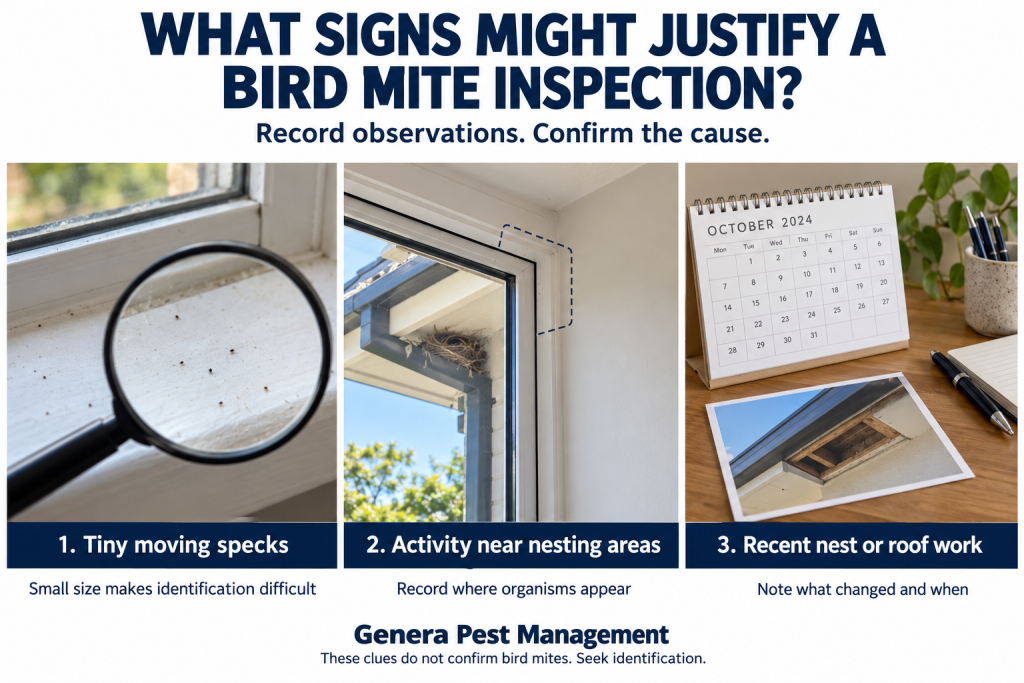
- Tiny moving specks: Bird mites can be less than one millimetre long. Their small size makes unaided identification difficult. sahealth.sa.gov.au
- Affected locations: Record where organisms appear, including walls, window areas or surfaces near the suspected source. Keep observations separate from assumptions about their origin.
- Recent work: Mention nest clearance, roof repairs or bird proofing. Explain exactly what was changed and when.
Photographs can document activity, but a magnified specimen may be more useful for identification. Ask the assessor how to collect and preserve a sample safely.
Can bites or itching confirm bird mites?
No, bites, rashes and crawling sensations do not identify the organism responsible. Similar symptoms can have several pest-related and medical causes.
- Avoid diagnosis from photographs: Skin appearance alone cannot reliably distinguish bird mites from other causes. A clinician assesses symptoms, while a pest specialist investigates the environment.
- Report evidence: Explain whether organisms have actually been seen or collected. An account of irritation is important, but it is different from identification.
- Investigate respectfully: Symptoms deserve attention even where no pest is found. Further environmental checks or medical assessment may be appropriate.
Australian public-health guidance recognises multiple causes of itching, including biting pests, household products and environmental irritants. health.wa.gov.au
What else could explain the problem?
Other pests and skin conditions should remain possible until evidence narrows the cause. Nearby birds do not rule out an unrelated issue.
- Other biting pests: Fleas, bed bugs, mosquitoes and rodent-associated mites may require different investigations. Tell the assessor about pets, travel and rodent activity.
- Skin irritation: Detergents, cosmetics and other products can contribute to irritation. Mention recent changes when discussing symptoms with your doctor.
- Medical conditions: Scabies and dermatitis need clinical assessment. They should not be diagnosed or treated through a bird-control appointment.
A published Australian medical-entomology discussion specifically warns that confusing bird-associated and rodent-associated mites can lead to unsuitable treatment. Correct identification directs the search for the source. www1.health.gov.au
How are suspected bird mites identified professionally?
Identification should examine collected organisms and connect the findings with the property investigation. A description such as “small red bugs” is not a complete diagnosis.
- Arrange sampling advice: Ask how and where to collect an environmental specimen. Avoid scraping your skin or applying substances to obtain samples.
- Request specialist input: Where identification is uncertain, the provider may need an entomologist or laboratory. Confirm arrangements and any separate costs.
- Understand the conclusion: Ask whether the finding confirms bird mites, another pest or an unidentified sample. The treatment recommendation should reflect that distinction.
Laboratory identification services recognise mites among organisms requiring accurate assessment before appropriate control is selected. Availability and submission requirements vary, so confirm a suitable service for your case. health.wa.gov.au
What should the nesting-site assessment cover?
The investigation should locate possible bird sources and establish whether nests remain occupied. Indoor treatment alone may leave the underlying activity unresolved.
- Likely locations: Discuss roof edges, wall cavities, window ledges and other sheltered areas. Include any photographs of birds entering the building.
- Occupancy: Ask whether adults, eggs or dependent young are present. A quiet nest is not necessarily vacant.
- Safe access: Explain solar panels, high roofs or restricted cavities. Additional trades or equipment may be needed to assess the source.
Native bird protections and applicable permissions must be considered before nest management. Do not seal an opening or remove an occupied nest simply because mites are suspected. www.environment.nsw.gov.au
Can bird mites continue after nest removal?
Yes, removing a nest does not establish that every mite has immediately disappeared. Remaining activity should be assessed alongside the completed work.
- Check the original source: Confirm which nest was removed and whether other nesting locations remain. Keep photographs and contractor records.
- Assess confirmed activity: Record organisms still appearing indoors. Ask whether further identification or targeted treatment is warranted.
- Avoid arbitrary deadlines: Duration depends on the species, host availability and whether the source has been addressed. Do not use an online lifespan estimate as a guarantee.
SA Health explains that bird mites require a bird host to complete their life cycle and that infestations are generally self-limiting after the bird source is eliminated. That does not replace assessment of persistent concerns. sahealth.sa.gov.au
What should a coordinated treatment plan include?
The plan should connect confirmed pest activity with appropriate source management, treatment and follow-up. Each action needs a defined purpose.
- Nest management: Establish when removal is appropriate and who will perform it. Confirm whether cleaning and disposal are included.
- Targeted treatment: Ask which areas need treatment and why. Product selection and use must follow applicable requirements and label directions.
- Occupant instructions: Obtain clear advice about preparation, access restrictions and re-entry. Explain relevant household circumstances before treatment.
Do not apply household or building pesticides to your skin. Avoid repeated spraying without identification, as unnecessary products may add irritation and obscure the investigation.
How does bird proofing prevent recurrence?
Suitable proofing addresses the building access that allowed nesting in the first place. It should follow occupancy checks and relevant repairs.
- Close assessed entry routes: Guards or building repairs may be suitable for particular openings. Preserve ventilation and other necessary functions.
- Check adjoining spaces: One repaired gap may leave another accessible. Ask what the proposed coverage includes.
- Maintain protection: Later roof work or equipment servicing can disturb barriers. Keep installation records and arrange checks when changes occur.
Explore Genera’s bird proofing services alongside assessment of the mite concern.
When should you seek medical advice?
Seek medical advice for persistent or unexplained itching, an uncertain rash or symptoms that are worsening. Pest treatment does not replace assessment of your health.
- Describe the circumstances: Tell your doctor about nesting activity, identified specimens and products already used. Avoid presenting a suspected cause as confirmed.
- Watch for infection: Seek care if affected skin becomes increasingly warm, tender or appears infected. Scratching can damage the skin.
- Ask about symptom relief: A doctor or pharmacist can advise on suitable treatment. Do not select scabies medication solely because the word “mite” is involved.
Healthdirect recommends medical review where bites appear infected or fail to improve, and where the cause of itching is uncertain. healthdirect
Frequently asked questions about bird mites
These answers clarify common concerns while keeping identification and medical assessment separate.
Can bird mites live under human skin?
Bird mites do not burrow into or live beneath human skin. That differs from human scabies mites.
- Seek medical assessment for persistent symptoms. Do not assume burrowing sensations identify a pest. sahealth.sa.gov.au
Does a bird nest prove I have bird mites?
No, a nearby nest is a possible source rather than confirmation. Environmental evidence still needs assessment.
- Record organisms and locations. Request identification before choosing treatment.
Will removing the nest resolve everything immediately?
Not necessarily, because remaining activity or another source may need attention.
- Confirm the removal scope. Agree on follow-up if organisms continue appearing.
Should I discard my mattress or furniture?
Do not discard belongings solely because bird mites are suspected. First establish the cause and appropriate response.
- Ask what evidence supports disposal. Obtain item-specific advice.
Can Genera investigate nesting birds and mites together?
Discuss both concerns when booking Genera’s bird mite service. Confirm the assessment coverage and access arrangements.
- Mention recent nest removal. Ask about identification, source investigation and follow-up.
Investigate the source before repeating treatment
Start with identification and a coordinated assessment of nearby bird activity. Genera Pest Management can help you discuss the environmental concern while your healthcare professional addresses symptoms.
- Share evidence: Provide observations, photographs and details of previous work.
- Request a clear plan: Confirm identification, nest assessment, treatment scope and prevention.
Call Genera Pest Management on 1300 149 549 or book a discovery call to discuss suspected bird mites at your Sydney property.