
The right bird control methods depend on where birds land, whether they are nesting and which areas need protection. Netting excludes birds from a defined space, while spikes and wire discourage landing on suitable surfaces. Some properties need a combination because protecting one ledge does not prevent access elsewhere.
If you have already bought deterrents without resolving the problem, choosing another product can feel like guesswork. Start by identifying the activity and deciding what successful protection should achieve.
This guide helps Sydney homeowners, strata committees and facilities managers compare options before requesting a quote.
What should you establish before comparing bird control methods?
Identify the species, behaviour and affected area before choosing equipment. A bird briefly landing on an exposed ledge presents a different challenge from birds occupying a sheltered nesting space.
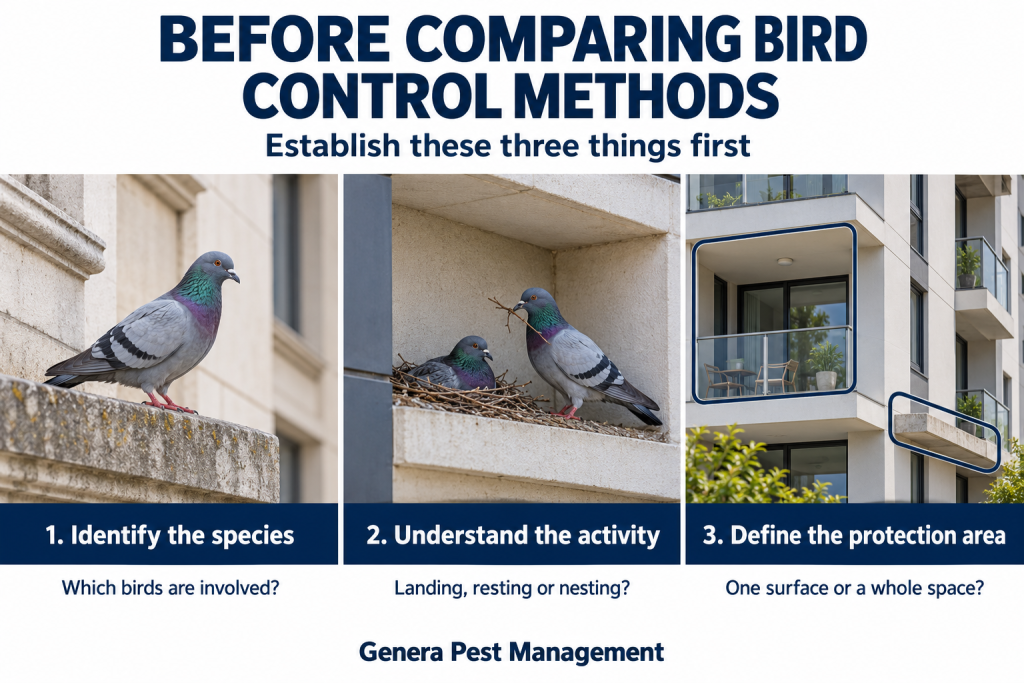
- Species: Confirm which birds are involved rather than relying on droppings alone. Product suitability can vary with bird size and behaviour.
- Activity: Record where birds feed, land, rest and nest. Note whether activity is occasional or repeated throughout the day.
- Protection goal: Decide whether you need an entire space excluded or particular surfaces protected. This gives contractors a clear basis for their recommendations.
Photographs and simple observations help explain the problem. Leave inaccessible areas for professional inspection.
How do bird netting, spikes and wire compare?
Netting protects a defined space, while spikes and wire target landing surfaces. Use this comparison as a starting point, with final selection based on inspection and product specifications.
- Compare equivalent coverage: A quote protecting one ledge is different from one enclosing the space behind it. Check the boundaries of each proposal.
- Include future access: Cleaning, lighting repairs and equipment servicing still need to be possible. Discuss these requirements before installation.
| Consideration | Bird netting | Bird spikes | Bird wire systems |
|---|---|---|---|
| Suitable locations | Balconies, roof voids beneath structures, canopies and building recesses | Suitable ledges, signs, beams and other landing surfaces | Suitable exposed ledges, parapets and selected beams |
| Target behaviour | Access to a defined resting or nesting space | Landing on the covered surface | Landing on the protected ledge |
| Appearance | Mesh and perimeter fixings may be visible | Upright elements visible at close range | Fine wires and posts generally have a discreet profile |
| Maintenance access | Planned openings may be required | Must accommodate cleaning and nearby servicing | Posts and wires must accommodate relevant servicing |
| Main limitations | Gaps, damage or poor design can compromise exclusion | Unsuitable species or incomplete coverage can limit results | Some systems suit lighter activity rather than established nesting |
| Maintenance | Check mesh, edges, fixings and wildlife hazards | Check attachment, damage and accumulated debris | Check posts, fixings, springs and wire tension |
Manufacturers provide different specifications for different systems. Net access openings, spike widths and wire suitability should therefore be confirmed for the proposed product. Bird Barrier
When is bird netting the better option?
Netting is worth considering when the objective is to prevent birds entering a whole space. Its suitability depends on whether that space can be enclosed effectively and maintained.
- Broader exclusion: A canopy or recessed balcony may contain numerous resting surfaces. A designed barrier can protect the enclosed area rather than treating each surface separately.
- Species selection: Mesh specifications must suit the target birds. Manufacturers offer different mesh sizes for different species, so appearance alone is insufficient when comparing products. Bird Barrier
- Service access: Ask where maintenance openings will be installed. Purpose-designed access points can allow servicing without cutting the netting. Bird Barrier
Netting requires regular checks. NSW guidance warns that inappropriate installation or poor maintenance can cause wildlife entanglement and injury. dpird.nsw.gov.au
When do bird spikes suit a property?
Spikes may suit specific surfaces where the aim is to discourage birds from landing. Their effectiveness depends on selecting the appropriate product and covering the usable surface.
- Ledge protection: Ask whether the spike width and layout match the ledge. A narrow strip may leave room beside or behind it.
- Attachment: The proposal should explain how the base will be secured to the particular material. Surface condition and preparation need consideration.
- Species limitations: Do not assume a pigeon deterrent will also resolve smaller bird activity. Manufacturer guidance recognises limitations with conventional ledge products for some small birds. Bird Barrier
Spikes protect the treated surface rather than enclosing the surrounding space. Review adjacent openings and alternative landing points during inspection.
When are bird wire systems appropriate?
Bird wire systems can suit exposed ledges where discreet landing deterrence is a priority. They use fine wires supported by posts, with tension maintained through the system’s components.
- Visual impact: Wire can be less noticeable than bulkier ledge products. Ask for photographs of comparable installations to assess the appearance.
- Bird behaviour: Suitability has limits. Bird Barrier specifies its conventional Birdwire system for light to medium activity on exposed ledges, rather than established nesting or sheltered roosting areas. Bird Barrier
- Detailed installation: Wire height, spacing and attachment must follow the selected system’s requirements. An improvised strand across a ledge is not equivalent to a designed installation.
Ask how tension and fixing condition will be inspected. A discreet system still needs maintenance.
Why might your property need a combination?
Different parts of a building can require different protection because birds use them differently. Combining methods should address documented activity rather than add products without a purpose.
- Apartment example: Netting might exclude a recessed balcony while a separate exposed ledge requires assessment. Each area needs a defined scope.
- Warehouse example: A canopy may need exclusion while nearby signage needs surface protection. Loading access and normal operations also influence the design.
- Solar array example: A compatible perimeter barrier may protect beneath panels. Nearby roof resting points are a separate issue from access under the array.
These examples illustrate planning choices rather than prescribe a solution. Ask the provider to explain what each proposed component contributes.
What can make an otherwise suitable system fail?
Incomplete coverage, remaining attractants and neglected maintenance can undermine the chosen method. Investigate why birds continue using the site before replacing everything.
- Untreated areas: Birds may move to a neighbouring ledge or opening. Inspect the surrounding structure as well as the original location.
- Food and shelter: Waste, feeding activity or accessible nesting spaces may continue supporting visits. Include practical changes in the management plan.
- Later building work: Repairs or servicing can disturb protection. Tell other contractors where systems are installed and arrange checks afterwards.
The useful measure is reduced access or fouling in the agreed area. Seeing a bird elsewhere on the property does not necessarily mean the installation has failed.
How do access, approvals and maintenance affect the choice?
A suitable design must work with the building’s access requirements and approval process. These considerations can influence the method as much as the purchase price.
- Installation access: Ask how high or difficult locations will be reached. Confirm whether access equipment is included.
- Approvals: Strata or other permissions may be relevant where common property or external appearance changes. Check the proposed fixings and design before ordering.
- Maintenance: Request written inspection requirements and repair arrangements. Confirm who responds to damaged components or trapped wildlife.
Occupied nesting areas also need assessment before exclusion. Closing access without checking can trap birds or separate adults from dependent young.
What should you ask before accepting a quote?
Request a recommendation that connects the inspection findings to the proposed work. This makes competing quotes easier to compare.
- Why this method? Ask which species and behaviour support the recommendation. Request an explanation of relevant limitations.
- What is included? Check coverage, preparation, cleaning, access equipment and any separate repairs. Obtain clarification where photographs or descriptions are unclear.
- What happens afterwards? Confirm warranties, maintenance obligations and follow-up charges. Agree how continuing activity will be assessed.
Explore Genera’s bird proofing services when discussing a property-specific proposal.
Frequently asked questions about bird control methods
These answers clarify common comparisons, but the final choice should follow inspection.
Is bird netting better than spikes?
Neither is universally better because they protect different things. Netting excludes a space, while spikes discourage landing on covered surfaces.
- Compare the intended protection area first. Avoid selecting solely by product price.
Are bird spikes suitable for every species?
No, species and product design affect suitability. Smaller birds can require a different approach.
- Ask the provider to identify the target birds. Request the proposed product’s specifications.
Can wire stop birds nesting in a recess?
Conventional wire systems may be unsuitable for established nesting areas. Product guidance and inspection should determine the approach.
- Ask whether complete exclusion is more appropriate. Do not rely on appearance alone.
Are these bird control methods humane?
Welfare depends on appropriate selection, installation and maintenance. Equipment alone does not guarantee a humane result.
- Check nesting areas before exclusion. Arrange prompt attention to damaged systems or trapped wildlife.
Which option costs the least?
Total cost depends on coverage, access and the work required. Comparing materials alone can be misleading.
- Request equivalent scopes from providers. Include maintenance and access costs in the comparison.
Choose bird protection with a clear purpose
Start with an assessment that explains which method suits each affected area. Genera Pest Management can help you discuss the activity and compare practical options.
- Share the problem: Describe where birds gather and how the activity affects your property.
- Review the plan: Ask about coverage, installation and maintenance before committing.
Call Genera Pest Management on 1300 149 549 or book a discovery call to discuss suitable bird control methods for your Sydney property.