
A bird control inspection in Sydney investigates the species present, their activity, entry routes and the conditions attracting them. The findings guide recommendations for management, cleaning, repairs or proofing. Before booking, confirm the inspection’s coverage, access arrangements and what documentation you will receive.
Genera Pest Management’s published service information describes inspection as the starting point for establishing the location and extent of nesting problems. Its commercial case studies also document assessment before selecting a management method. Pest Control Company Sydney
If birds keep returning, you need to understand why before paying for another deterrent. This guide explains that assessment approach and helps you prepare useful information for your appointment.
What happens before the site visit?
The initial discussion establishes what you have noticed and what needs investigating. Clear information helps Genera understand the affected property and plan the assessment.
- Describe the activity: Explain where birds gather, when they appear and whether you suspect nesting. Mention how long the problem has continued.
- Explain the impact: Identify affected rooms, balconies, entrances or business operations. Distinguish what you have directly observed from what you suspect.
- Discuss previous attempts: Share details of cleaning, installed deterrents or earlier treatments. Explain whether those measures changed the activity.
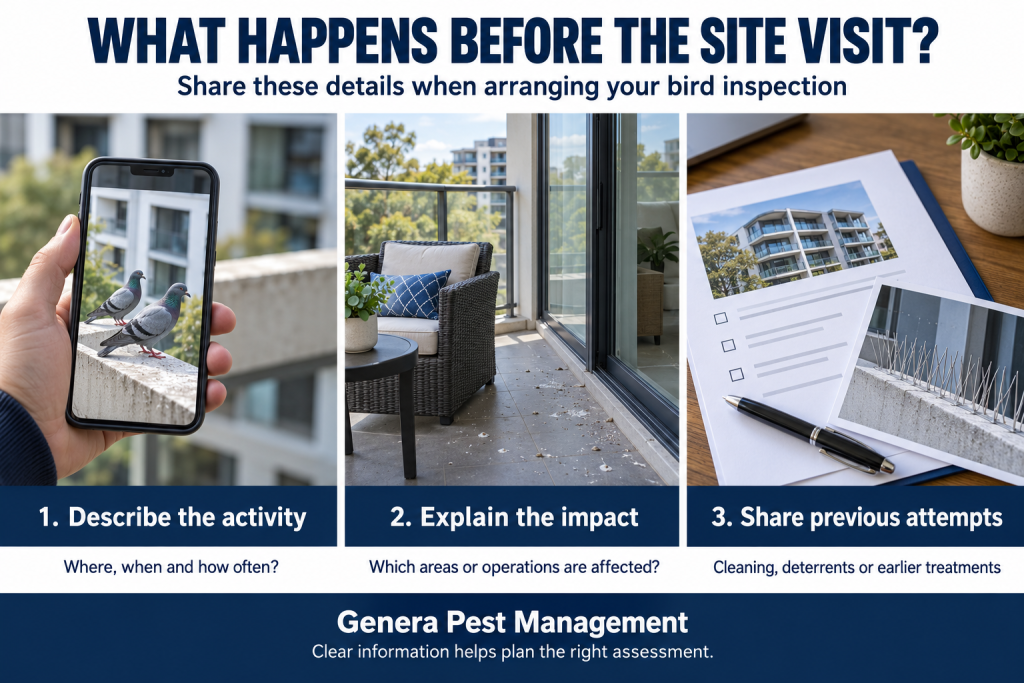
Genera’s published commercial process describes a discovery call covering sightings, affected buildings, operating hours, previous treatments and immediate concerns. generapestmanagement.com
How should you prepare for a bird inspection?
Prepare observations, relevant access information and any existing records without disturbing birds or contaminated material. You do not need to investigate concealed areas yourself.
- Gather photographs: Take wide views showing the location and closer images where safely possible. Short videos can capture entry behaviour that may not occur during the visit.
- Arrange authorised access: Confirm keys, escorts and permission to enter relevant areas. For strata properties, identify the person responsible for approving inspection access.
- Provide useful documents: Previous reports, installation photographs and repair records can explain the property’s history. Mention solar equipment or other services near suspected nesting areas.
Keep pets away from the inspection area as agreed. Ask whether a representative should attend to explain recurring activity and discuss findings.
How are bird species and activity checked?
The assessment considers which birds are present and whether they are feeding, resting, nesting or passing through. Those distinctions influence the management options.
- Species identification: Ask which observations support the identification. Where visibility is poor, further observation may be necessary.
- Behaviour: Explain whether birds remain for long periods or visit briefly. Carrying material or repeatedly entering a recess warrants closer assessment.
- Activity patterns: Share when birds are usually present. A quiet appointment does not necessarily mean the reported problem has ended.
Genera’s Randwick hotel case study describes assessment of roosting, nesting, feeding and movement around the property. These observations informed the response to that particular infestation. Pigeon Control Case Study
How are entry points and movement patterns investigated?
The inspection seeks to establish how birds reach affected spaces and which routes they repeatedly use. Access may involve a building opening or an ordinary entrance used at predictable times.
- Building access: Ask which gaps or openings were confirmed as active. A visible defect should not automatically be described as the cause without supporting evidence.
- Movement between areas: Identify whether birds travel between ledges, feeding locations and sheltered spaces. This helps define the extent of the investigation.
- Human activity: Mention deliveries, door opening and daily routines that coincide with bird entry. These details can explain behaviour that building photographs alone miss.
In Genera’s Sydney university food court project, technicians observed pigeons entering through automatic doors activated by student movements. That finding shaped the site-specific management plan. generapestmanagement.com
Why are food, water and shelter assessed?
A useful bird site assessment investigates what encourages birds to remain or return. Physical protection may need support from housekeeping or operational changes.
- Food sources: Point out exposed feed, outdoor dining and waste storage. Include nearby feeding activity where you have observed it.
- Water: Report leaks or persistent pooling around affected areas. Ask whether maintenance changes would support the recommended response.
- Shelter: Discuss recessed ledges, roof structures and other protected locations. Several adjoining areas may contribute to the same problem.
Genera’s hotel case study identifies food, water, shelter and surrounding building features as relevant assessment considerations. It explains why addressing one visible resting place may leave the wider problem unresolved. Pigeon Control Case Study
What happens when nesting or contamination is found?
Nesting and fouling findings should be assessed before removal, cleaning or exclusion is recommended. The appropriate next step depends on occupancy, access and the affected location.
- Occupied nests: Ask whether eggs or dependent young are present. Native bird protections and applicable permissions must be considered before relevant work proceeds. www.environment.nsw.gov.au
- Affected surfaces: Identify droppings or debris around furniture, entrances, equipment and other used areas. Ask whether cleaning needs separate specialist assessment.
- Other defects: Request clarification where roof damage or electrical concerns are suspected. A bird inspection does not replace the relevant trade inspection.
Avoid sealing openings before occupancy has been checked. Genera’s bird nest removal service describes inspection of the nesting location and extent before removal work.
Will the inspector photograph findings?
Photographs can make findings and proposed coverage easier to understand, but confirm the documentation included when booking. Genera’s public information does not establish an identical photographic reporting package for every appointment.
- Ask about records: Confirm whether you will receive photographs, written findings or marked images. State any documentation your strata committee or facilities team needs.
- Clarify locations: Request labels or descriptions where several similar roof sections are involved. Useful records should connect findings to identifiable areas.
- Record limitations: Ask which spaces could not be inspected and why. Photographs of accessible areas do not establish the condition of concealed spaces.
Documentation is particularly useful when another contractor must price repairs. Confirm that sharing arrangements suit the property owner’s requirements.
How do findings become a bird management plan?
The plan should connect observed activity with practical recommendations and explain the intended result. It may involve several actions rather than immediate installation of one product.
- Recommended works: Ask why each measure suits the species, behaviour and building. Clarify which locations the proposed protection covers.
- Supporting changes: Establish whether cleaning, waste management or building repairs are needed. Identify who is responsible for each task.
- Sequence: Confirm whether nest reassessment, approvals or specialist work must occur first. Understand what can proceed immediately and what depends on another step.
Genera’s published commercial approach links site assessment with a management recommendation and quotation. The precise scope remains dependent on the property. generapestmanagement.com
What should you clarify in the quotation?
The quote should define the work sufficiently clearly for you to understand its coverage and cost. Inspection findings and installation inclusions are related, but they are not interchangeable.
- Included tasks: Check preparation, access equipment, cleaning, materials and disposal. Ask about separate charges for reassessment or other contractors.
- Protection boundaries: Request clear descriptions of treated surfaces or enclosed spaces. Confirm any areas deliberately left outside the proposal.
- Conditions: Read payment terms, warranty provisions and maintenance requirements. Agree how additional findings will be discussed before extra work proceeds.
For prevention options, review Genera’s bird proofing services. Ask how the proposed work relates to your inspection findings.
How are follow-up arrangements decided?
Follow-up should reflect the management method, observed activity and maintenance needs. Confirm the schedule and responsibilities rather than assuming every service includes the same visits.
- Review the result: Agree what will be checked after work. This might involve renewed entry, activity in protected areas or installation condition.
- Maintain protection: Ask how barriers should be inspected and repaired. Netting requires regular checks to reduce wildlife entanglement risks. www.dpird.nsw.gov.au
- Report changes: Keep dated observations of returning birds or fresh fouling. Mention later building work that may have disturbed installed protection.
Genera’s Randwick project included a final inspection and recommendations for future monitoring. Its schedule and results relate to that project, rather than every booking. Pigeon Control Case Study
Frequently asked questions about bird inspections
These answers help clarify booking expectations before a bird infestation inspection.
How long does a bird inspection take?
Duration depends on the property, access and investigation required. A balcony and a commercial complex require different consideration.
- Ask for an appointment estimate. Confirm whether additional observation may be needed.
Do I need to be present?
Confirm attendance requirements when booking. Someone familiar with the activity can provide useful context.
- Arrange an authorised representative where needed. Ensure access instructions are available.
Will treatment happen during the inspection?
Do not assume assessment includes immediate treatment. Recommended work may require approval, preparation or another appointment.
- Ask what the booking covers. Confirm any separate treatment charges.
Can birds be assessed if they are absent?
Previous observations and visible evidence can still help, but absence may limit conclusions. Further checks may be appropriate.
- Provide dated photographs or videos. Explain the usual activity times.
Is a bird inspection free?
Confirm fees and inclusions before booking. A quotation, detailed inspection and specialist access may involve different arrangements.
- Request written clarification. Ask what documentation the appointment includes.
Prepare for a clear next step
A useful inspection gives you a reasoned basis for deciding what work to approve. Genera Pest Management can help you discuss the activity and arrange the appropriate assessment.
- Share your observations: Describe the location, timing and effect of the bird problem.
- Confirm the booking: Clarify access, fees, documentation and follow-up expectations.
Call Genera Pest Management on 1300 149 549 or book a discovery call to discuss a bird control inspection in Sydney.